
In cement production processes, flow control valves and flow control gates play a vital regulatory function. To better understand their importance, we first need to clarify a few basic concepts:
What is the purpose of flow control? The fundamental purpose of flow control is to precisely regulate the flow parameters of process media (gas, liquid, powder), ensuring stable, efficient, and safe production. Specifically for cement plants, it means controlling the flow, pressure, and temperature of key media such as raw meal, pulverized coal, and hot air to achieve optimal combustion efficiency, product quality, and energy consumption levels. Whether using a motorized flow control gate or a pneumatic flow control gate, the objective remains consistent: precise process regulation.
1. Typical Working Conditions and Valve Challenges in Cement Plants
Harsh Environmental Conditions
High Dust: Raw meal grinding and cement mill areas have extremely high dust concentrations, requiring robust flow control gates with effective sealing.
High Temperature: Kiln exit gas temperatures can reach 300-450°C, and the kiln inlet is even hotter, demanding specialized materials for both pneumatic flow control and electric control systems.
High Abrasion: Raw materials, clinker, and coal powder are highly abrasive, necessitating hardened surfaces on control gates and valves.
Corrosiveness: Ammonia water for denitrification and moist sulfur-containing gases are corrosive, requiring appropriate material selection for all flow control equipment.
Process Control Requirements
Response Speed: Airflow and pressure require rapid adjustment, making pneumatic flow control gates particularly suitable for such applications.
Reliability: Continuous production demands high reliability to avoid unplanned downtime, whether using motorized or pneumatic systems.
Explosion-proof Requirements: Coal preparation and conveying areas are classified as hazardous zones, where pneumatic flow control offers intrinsic safety advantages.
Precision Needs: Critical process points require precise control, which can be achieved through both motorized flow control gates and advanced pneumatic systems with precision positioners.
2. Application Advantages and Selection Points for Pneumatic Control Valves
Pneumatic valves and pneumatic flow control gates are often the best choice for cement plants. Their core advantages are:
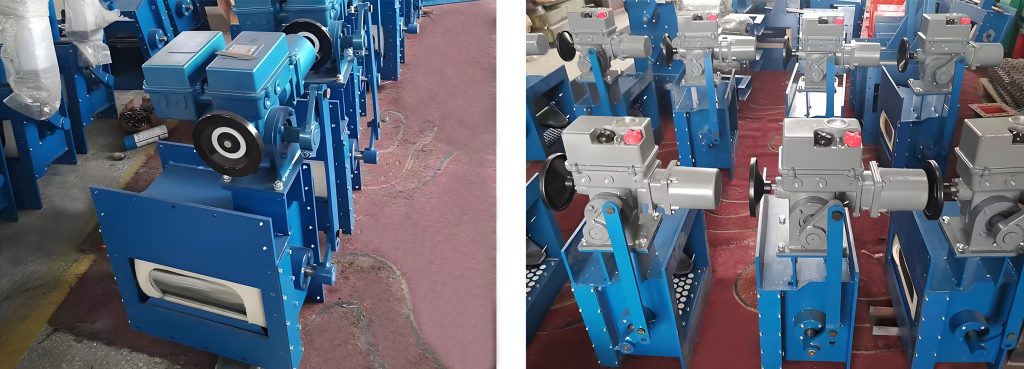
Intrinsic Safety: Essential for hazardous areas like coal mills; no electrical spark risk. A blue pneumatic flow control gate placed on a pallet inside a warehouse typically comes with all necessary safety certifications for hazardous environments.
Fast Response: Ideal for rapid airflow changes and dust filter pulse valves (millisecond action). How does pneumatic flow control work? It utilizes compressed air for nearly instantaneous response.
High Reliability & Easy Maintenance: Simple mechanical design, easy to repair, tolerates dust well—perfect for pneumatic flow control gates in challenging cement plant environments.
Typical Applications:
- Hot Gas Flow Control Valves/Gates (Kiln Inlet/Outlet): Use high-temperature pneumatic flow control gates or butterfly valves with special seals and extended stems.
Coal Conveying & Metering Gates: Use pneumatic flow control gates with V-port designs and hardened surfaces, featuring certified safety features for explosive environments.
Dust Collector Pulse Valves: Use dedicated diaphragm valves built for millions of cycles, representing a specialized form of pneumatic flow control.
3. Application Scenarios for Electric Control Valves
Motorized flow control gates and electric valves are better suited for specific tasks:
High-Precision Control Points: e.g., raw meal batching, precise ammonia dosing where motorized flow control gates offer superior positioning accuracy.
Areas Without Compressed Air: Remote auxiliary plants or temporary setups where motorized systems eliminate the need for air compressors.
Points Requiring Complex Control Logic: Deep integration with DCS systems where motorized flow control gates with smart controllers excel.
Typical Applications:
Raw Meal Homogenizing Silo Flow Control: Motorized flow control gates or electric sleeve valves with smart actuators for precise material regulation.
Denitrification Ammonia Dosing Valves: Motorized flow control gates configured as electric single-seat valves with corrosion-resistant alloys for exact chemical addition.
Waste Heat Recovery System Valves: Motorized control gates rated for medium pressure/temperature steam applications.
4. Valve Selection Matrix by Plant Area
| Plant Area | Main Control Point | Recommended Type | Key Reason | Typical Equipment Form |
|---|---|---|---|---|
| Raw Material Prep | Raw Meal Feed | Electric | High precision required | Motorized flow control gate with precision positioning |
| Coal Preparation | Coal Feed & Transport | Pneumatic | Explosion-proof requirement | Pneumatic flow control gate with ATEX certification |
| Kiln System | Main Fan Inlet Damper | Pneumatic | Fast response, high temperature | High-temperature pneumatic flow control gate |
| Cement Grinding | Separator Airflow | Pneumatic | Fast response, simple maintenance | Standard pneumatic flow control gate |
| Environmental | Ammonia Dosing | Electric | Extreme precision, corrosion resistance | Motorized flow control gate with corrosion-resistant materials |
| Environmental | Dust Collector Pulse Valve | Pneumatic | Millisecond response required | Specialized pneumatic flow control diaphragm valve |
| Utilities | Cooling Water | Electric | Standard duty, easy power access | Basic motorized flow control gate |
5. Key Technical Explanations
What is the function of a control valve? It regulates flow, provides tight shut-off, ensures safety, and can divert/mix flows.
How does pneumatic flow control work? A DCS signal (4-20mA) goes to a valve positioner, which converts it to an air pressure signal (0.2-1.0 bar). This drives an actuator (diaphragm/piston), moving the valve stem to change the flow area. Position feedback creates a closed-loop for accuracy.
6. Special Selection Considerations
For High Temperatures: Use extended bonnets, cooling fins, and high-temperature graphite packing on both valves and flow control gates.
For Abrasion: Apply hardened surfaces (stellite, tungsten carbide, ceramic linings) to gate surfaces and valve components.
For Hazardous Areas: Use certified intrinsically safe pneumatic flow control systems or appropriately rated motorized gates.
For Smart Features: Use digital positioners for diagnostics and predictive maintenance on both valve types and flow control gates.
7. Maintenance & Lifecycle Cost Comparison
Pneumatic Flow Control Gate Maintenance: Check air supply, calibrate positioner regularly, inspect seals and gate surfaces. Lower initial cost, simpler repairs. A blue pneumatic flow control gate placed on a pallet inside a warehouse represents this cost-effective, easily maintained solution.
Motorized Flow Control Gate Maintenance: Check motor temperature, seals, gearbox oil, and gate mechanism. Higher initial cost, less frequent but potentially complex repairs.
10-Year Total Cost: Pneumatic flow control gates typically have a medium total cost, while motorized flow control gates are medium-high.
8. Five-Step Practical Selection Process
Define Parameters: Media, temperature, pressure, control needs, environment. Determine if a pneumatic flow control gate or motorized version is more appropriate.
Choose Type: Pneumatic flow control for hazardous/fast/hot areas; Motorized flow control gates for precise/complex control.
Determine Specifications: Calculate Cv/Kv, select size and materials for either gate type.
Select Accessories: Positioner, limit switches, air filter regulators for pneumatic systems; controllers and feedback devices for motorized gates.
Verify & Optimize: Check operating range, turndown, cavitation, and noise for the selected flow control gate design.
Conclusion
Selecting the right valve for a cement plant is a balance of technology and economics. The core principle is safety first, then process compatibility, then lifecycle cost.
Choose pneumatic valves for safety, harsh conditions, and fast response. They are the default for most cement plant applications.
Choose electric valves for high precision and complex control in suitable areas.
Understanding the purpose of flow control, the function of control valves, and how pneumatic control works forms the foundation for correct selection. Building a complete valve management system—from selection and installation to maintenance—ensures stable production and controlled costs.
 English
  Russian
  French
  Portuguese
  Arabic
  Spanish
  Japanese