
In industries such as mining, sand and gravel processing, coal preparation, cement, building materials, and chemical manufacturing, belt conveyors serve as the core equipment for continuous material transportation. However, belt conveyor transfer points, including material drop points, receiving points, and chute areas, are the primary sources of industrial dust emissions.
Dust generation at conveyor transfer points is mainly triggered by material drop impact, mechanical vibration, and induced airflow turbulence. Without effective control, fugitive dust will continuously escape from sealing gaps, deteriorating on-site working conditions and bringing severe environmental compliance pressures for factories.
Most failed conveyor dust control projects stem from relying solely on single dust removal equipment. To achieve stable and standard dust suppression, enterprises should adopt a systematic solution combining local enclosure sealing and centralized dust extraction. This article shares practical belt conveyor dust suppression retrofit experience for industrial plants, helping resolve transfer point dust emission issues fundamentally.
1. Why Conveyor Transfer Points Generate Large Amounts of Fugitive Dust
The special structural and operating characteristics of conveyor transfer points make them the key dust-producing areas in material handling systems. The main causes of fugitive dust are summarized as follows:
- Material drop impact: Vertical drop height causes materials to collide with belts, chutes and baffles, stirring up fine dust particles.
- Induced airflow disturbance: Falling materials drive surrounding air to flow, forming internal turbulent airflow that pushes fine dust outward.
- Equipment vibration diffusion: Continuous belt operation vibration raises accumulated dust and causes secondary dust emission.
- Poor chute sealing: Aging or missing sealing components lead to obvious dust leakage from gaps.
- Closed local space: The narrow structure of transfer points prevents natural dust dissipation, resulting in concentrated dust accumulation.
The material drop point is the core dust source. When internal enclosure sealing is insufficient, negative pressure failure will cause massive fugitive dust escape. Therefore, transfer point dust control must prioritize source sealing rather than only relying on terminal dust collectors.
2. On-site Investigation: Accurately Locate Dust Leakage Paths
Customized belt conveyor dust control solutions start with detailed on-site investigation. Different working conditions lead to completely different dust generation characteristics. Only by clarifying dust sources and diffusion paths can the enclosure structure and dust extraction system achieve optimal performance.
Key investigation items for conveyor transfer points:
- Material parameters: drop height, particle size, moisture content, and abrasiveness
- Conveyor operating parameters: belt width and running speed
- Operation status: material dropping direction and receiving position
- Sealing condition: chute tightness and main dust leakage gaps
- Site constraints: maintenance passages, surrounding equipment and installation space
Common on-site dust problems include impact dust at drop points, side leakage from guide chutes, and secondary dust caused by belt operation. Targeted rectification is required for different failure scenarios.
3. Local Enclosure Sealing: Core of Source Dust Suppression
Local enclosure is the foundational step of effective conveyor transfer point dust suppression. The purpose of sealing is not fully blocking equipment operation, but limiting dust within a relatively closed space, creating stable negative pressure conditions for subsequent dust extraction.
Inadequate enclosure is the main reason why many high-power dust collectors fail to reduce dust. Massive air leakage will offset the negative pressure of the dust removal system, resulting in persistent fugitive dust.
Common and effective enclosure transformation measures:
- Guide chute sealing upgrade and wear-resistant rubber skirt installation
- Drop point closed hood and receiving point dust cover customization
- Flexible dust curtain configuration for dynamic sealing
- Buffer device transformation to reduce material drop impact
- Optimization of drop angle and height to weaken induced airflow
During the sealing transformation, maintenance and observation requirements must be reserved. Over-sealing that affects daily belt operation and equipment overhaul should be avoided to ensure long-term practicality of the system.
4. Dust Collection System: Realize Terminal Dust Purification
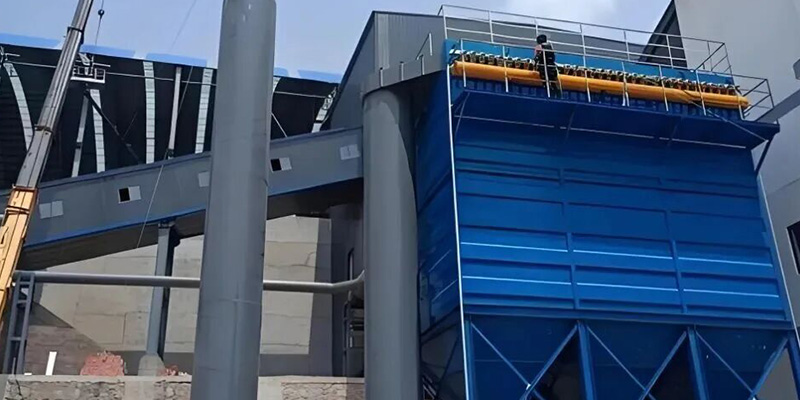
While local enclosure restricts dust diffusion, the industrial dust collection system is responsible for collecting and purifying suspended dust inside the closed space, forming a complete set of belt conveyor dust control solutions.
Standard working process of transfer point dust removal: On-site closed structure & reserved air suction ports → Dust pipeline connection → Fan provides stable negative pressure → Dust-laden air is sent to dust collector → Purified air reaches emission standard → Collected dust is discharged and recycled through ash discharge system.
Baghouse dust collectors are the most widely used equipment for conveyor transfer point dust treatment, suitable for high-concentration industrial dust working conditions in mining, sand and gravel, and coal preparation plants. The equipment model selection needs to comprehensively consider air volume, dust characteristics, material humidity, operating temperature and on-site space.
For multiple centralized transfer points, a centralized dust collection system is recommended; for scattered single points with small air volume, independent local dust removal equipment can be configured to reduce operating costs.
5. Suction Hood Layout & Air Volume Design: Key to System Efficiency
Reasonable suction hood arrangement and air volume calculation determine the final effect of conveyor dust suppression. The suction hood should be close to the core dust source without interfering with belt material transportation and daily equipment maintenance.
Excessively long distance between the suction port and dust source will lead to premature dust diffusion and poor collection effect. Unreasonable layout may also suck in bulk materials unnecessarily, increasing pipeline wear and system operating load.
Air volume and wind speed design need to balance multiple working conditions:
- Insufficient air volume leads to incomplete dust collection and residual fugitive dust
- Excessive air volume causes material suction loss and increases operating costs
- Low pipeline wind speed results in dust deposition and pipeline blockage
- High wind speed accelerates pipeline and equipment abrasion
- Multi-point shared systems require precise air volume balance to avoid local negative pressure deficiency
The dust removal system must be designed as a whole according to the number of transfer points, pipeline layout and equipment resistance, instead of simple one-to-one equipment matching.
6. Pipeline & Ash Discharge System Optimization: Guarantee Long-term Stable Operation
Most enterprises only focus on closed hoods and dust collectors in conveyor transfer point dust control renovation, ignoring pipeline and ash discharge system design, which leads to frequent failures in long-term operation.
Dust pipeline design key points: Adopt smooth pipeline layout, reduce redundant elbows, maintain reasonable internal wind speed, reserve inspection ports, control excessive horizontal pipe sections, and avoid dust deposition and blockage.
Ash discharge system design key points: Optimize hopper angle to ensure smooth dust self-flow, configure reliable ash discharge valves to prevent blockage, facilitate dust recovery and transportation, and reserve convenient operation space for maintenance personnel.
For high-yield dust working conditions such as mines and coal preparation plants, unsmooth ash discharge will directly increase dust collector resistance, cause equipment overload, and affect the continuous and stable operation of the entire dust removal system.
7. Daily Maintenance Mechanism: Sustain Long-term Dust Control Effect
Belt conveyor dust suppression renovation is a one-time transformation, but dust control is a long-term systematic work. Transfer points are affected by continuous material impact and vibration, and sealing accessories and vulnerable parts are prone to aging and wear. Regular maintenance is essential to maintain stable dust removal effect.
Core daily inspection checklist for dust control systems:
- Check the integrity of chute seals, rubber skirts and dust curtains
- Inspect suction hoods and pipelines for blockage and air leakage
- Monitor dust collector pressure difference and check filter bag damage or clogging
- Verify stable operation of fans and pulse cleaning systems
- Confirm smooth operation of ash discharge system without blockage
Timely replacement of worn accessories and regular system debugging can effectively avoid dust rebound and ensure long-term compliance of on-site environmental indicators.
8. Complete Retrofit Framework for Conveyor Transfer Point Dust Control
To solve belt conveyor transfer point fugitive dust efficiently and permanently, enterprises shall follow the mature and systematic transformation process:
- On-site condition investigation: Locate key dust emission points such as drop points, receiving points and guide chutes, and clarify dust generation rules.
- Source enclosure upgrading: Adopt targeted sealing measures to block dust leakage gaps and realize source dust suppression.
- Scientific system design: Arrange suction ports reasonably, calculate matching air volume, and avoid affecting normal production operations.
- Customized equipment selection: Select baghouse dust collectors and supporting components according to actual working conditions such as dust concentration and material properties.
- Supporting system optimization: Optimize pipelines and ash discharge structures to eliminate hidden dangers of blockage and excessive system resistance.
- Standardized daily maintenance: Establish a perfect inspection and maintenance mechanism to sustain long-term dust control effect.
Conclusion
Belt conveyor dust control is not a simple equipment installation project, but a systematic solution integrating sealing, dust extraction, pipeline design and daily operation and maintenance. For mining, sand and gravel, coal preparation and building material enterprises facing transfer point dust overflow and environmental pressure, customized conveyor transfer point dust suppression transformation can effectively improve the workshop environment, meet environmental protection emission standards and reduce enterprise operation risks.
If you are troubled by conveyor drop point dust, chute dust leakage and fugitive dust emission problems, professional on-site survey and customized dust control solutions can be provided according to your actual working conditions and emission requirements.
 English
  Russian
  French
  Portuguese
  Arabic
  Spanish
  Japanese