What is the Maximum Incline Angle for Belt Conveyors Transporting Powder?

Abstract: In industries such as mining, electric power, and building materials, powder transportation faces incline angle limitations due to the strong fluidity of materials. This article will deeply analyze the key factors affecting the maximum conveying incline angle of powder, compare the technical differences between conventional belt conveyors and large-incline corrugated sidewall ベルトコンベヤ, and provide a complete selection guide covering material characteristics, equipment selection, and dust-proof solutions, suitable for heavy industries such as mining, cement, electric power, and metallurgy.

I. Core Challenge: Why is the Incline Angle Limited for Powder Transportation?

In the production of heavy industries (electric power, iron and steel, building materials, environmental protection), when using general-purpose belt conveyors to transport powdery materials such as fly ash, mineral powder, and cement raw meal, the maximum safe incline angle is usually much lower than that for bulk or granular materials. The core reason is that powder has a small internal friction coefficient and high fluidity, resulting in limited effective static friction force in contact with the conveyor belt. If the incline angle is too large, materials are prone to sliding backward, spilling, and even dust emission, which seriously affects conveying efficiency and on-site environment.
Key Concept: The primary basis for determining the maximum incline angle is the angle of repose (angle of rest) of the material, which reflects the stability of the powder in a naturally accumulated state. Generally, the design incline angle of the conveyor needs to be 5°-15° smaller than the dynamic angle of repose of the material to ensure reliable operation.

II. Solution: Leap from Conventional Belt to Large-Incline Technology Conventional Mining Belt Conveyors

Incline Angle Range: For most dry powders, when using smooth or herringbone pattern conveyor belts, the recommended maximum incline angle is generally not more than 16°-22°. For example, dry cement powder is about 18°, and fine fly ash may need to be reduced to below 15°.
Limitation: The ability to increase the incline angle is close to the physical limit.

Large-Incline Corrugated Sidewall Belt Conveyors (Revolutionary Solution)

Working Principle: Through the combination of corrugated sidewalls and transverse partitions (T-type, TC-type, etc.), continuous and closed “box-shaped buckets” are formed on the conveyor belt to completely hold the materials and overcome sliding.
Performance Breakthrough: The maximum conveying incline angle can be greatly increased to 30°-90°, realizing vertical lifting, which is especially suitable for working conditions with limited space and large lifting height.
Core Advantages: Saving floor space, improving efficiency, reducing transfer points, and lowering overall investment costs.

III. Selection Decision: In-Depth Analysis of Five Key Factors

Material Characteristic Analysis

Angle of Repose (Angle of Rest) and Humidity: The smaller the angle of repose, the lower the allowable incline angle. Appropriate humidity may increase adhesion and allow a slightly larger incline angle, but excessive humidity will lead to caking and sticking to the belt.
Bulk Density and Particle Size: Lightweight and ultra-fine powders (such as microsilica powder) are easy to drift, so the incline angle needs to be more conservative.
Recommendation: Conduct material characteristic tests to obtain accurate data such as angle of repose and friction coefficient.

Conveyor Belt Selection and Design

Conventional Belts: Herringbone pattern conveyor belts can be selected to increase friction, but the improvement effect is limited.
Large-Incline Sidewall Belts: The sidewall height (commonly 60-630mm) and partition spacing need to be determined according to the conveying capacity and particle size. The belt width and belt strength need to be specially calculated.

Auxiliary Devices and Sealing

Belt Pressing Device: When the incline angle exceeds 60°, it is usually necessary to set belt pressing wheels on the return section to prevent belt fluttering.
Full Sealing Cover: To achieve dust-free transportation, it is recommended to select a fully enclosed belt conveyor, which can effectively prevent dust emission and meet environmental protection requirements.

Drive and Brake Safety

For large-incline downward transportation, the braking power needs to be calculated to prevent overspeed (runaway).

Reliable backstops or brakes should be equipped to ensure safe shutdown.

Economy and Spatial Layout

Comprehensively compare the life-cycle costs of the large-incline conveying scheme with the “conventional belt + long-distance climbing or multi-stage lifting” scheme.
The initial investment of large-incline equipment may be higher, but the long-term savings in power consumption, maintenance costs and site value are significant.
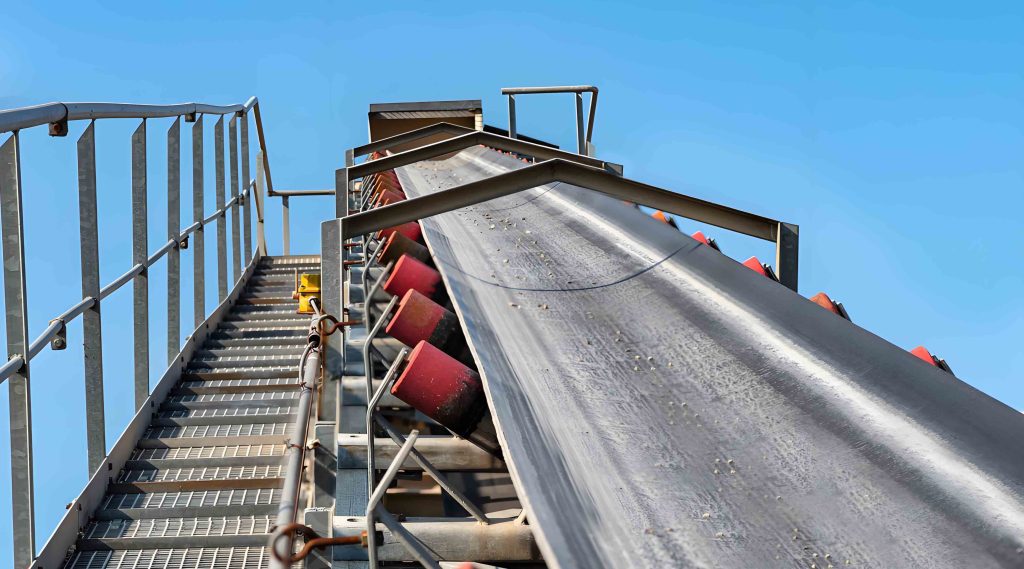
これは、赤と黒のコンベアローラーを備えたベルトコンベヤで、さまざまな材料の輸送と処理に適しています。

結論と提言

The maximum incline angle for powder transportation is not a fixed value, but a balance of material characteristics, equipment technology and economy.
Conventional, Low-Incline Transportation: Prefer conventional belts and control the incline angle within 20°.
Large-Incline, High Space Utilization Transportation: Large-incline corrugated sidewall belt conveyors are a mature and reliable choice.
High-Standard Environmental Protection Requirements: Be sure to match the fully enclosed dust-proof cover.
If you need to customize a conveying scheme according to your powder type, please feel free to contact us for professional support.

下記フォームよりお気軽にお問い合わせください。24時間以内にご返信いたします。

* 名前:
国 :
* 電子メール:
Tel :
メッセージ :