
A バッグハウス集塵機 is the most widely used industrial dust extraction system for factory air pollution control, serving cement, metallurgy, chemical processing, woodworking, and manufacturing facilities. Proper baghouse maintenance is essential to sustain stable dust collector efficiency, prevent excessive emissions, and avoid unplanned equipment downtime. Regular inspection and systematic upkeep effectively resolve common issues such as filter bag clogging, high differential pressure, air leakage, and ash hopper blockage, extending the service life of your industrial dust removal equipment.
This complete pulse baghouse dust collector maintenance guide covers daily shift checks, weekly routine servicing, monthly deep overhaul, quarterly major repair, specialized system upkeep, and fault troubleshooting. It provides practical, field-verified standards for equipment operators and maintenance engineers to maximize dust removal performance and reduce operational costs.
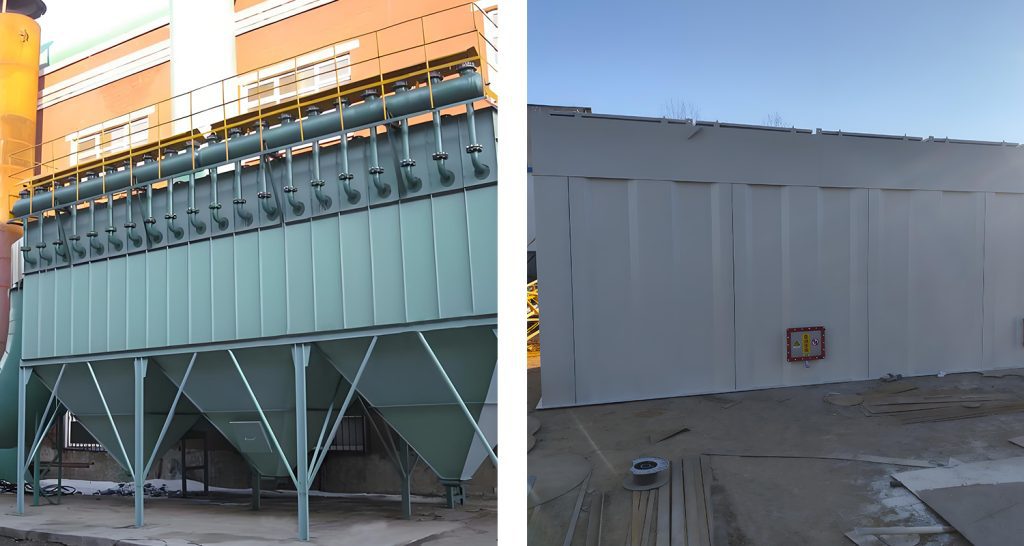
1. Daily Shift Inspection Routine (Before, During, After Operation)
Daily patrol inspection is the foundation of reliable pulse baghouse operation. A standardized three-stage check eliminates hidden failures, ensures consistent dust cleaning performance, and prevents minor defects from evolving into costly equipment breakdowns.
1.1 Pre-Startup Equipment Check
Verify all mechanical and pneumatic systems are qualified before activating the industrial dust collector:
- Compressed air system check: Maintain pulse cleaning air pressure between 0.3~0.5MPa. Drain water from the air storage tank daily to prevent moisture ingress that causes フィルターバッグ paste blockage.
- Pulse valve and pipeline inspection: Check all pulse valves and blowpipe manifolds for air leakage and confirm solenoid valve indicators function normally.
- Ash discharge mechanism inspection: Examine oil levels for star shape dischargers and screw conveyors. Perform manual cranking to ensure smooth rotation and mechanical flexibility.
- System sealing inspection: Ensure access doors, manholes, and flange gaskets are fully sealed. Uncontrolled air leakage causes low-temperature condensation and chronic filter bag fouling.
- Winter cold weather protection: Confirm ash hopper heating and thermal insulation systems are active to stop dust moisture agglomeration and blockage.
1.2 In-Operation Real-Time Monitoring
Real-time data monitoring allows early diagnosis of baghouse dust collector faults and maintains optimal operating conditions:
- Key differential pressure monitoring: Normal operating differential pressure ranges from 800~1500Pa. Sustained high differential pressure indicates ineffective pulse cleaning, filter bag fouling, or dust hardening. A sudden pressure drop signals filter bag damage or tube sheet ash leakage, leading to unqualified exhaust emissions.
- Stack emission observation: Visible smoke or dust at the chimney directly confirms broken filter bags and system leakage.
- Abnormal noise detection: Document unusual vibrations, friction sounds from discharge motors, and pulse valve air leakage for timely repair.
- Pulse cleaning cycle verification: Ensure online and offline dust cleaning cycles and pulse duration run according to operational parameters.
- Fan system monitoring: Track fan current and operating temperature to prevent overload operation and mechanical wear.
1.3 Post-Shutdown Maintenance Check
Complete finishing maintenance after full equipment stop and natural box cooling:
- Inspect access door seams and box gaps for residual ash leakage.
- Fully drain condensed water from air tanks and pneumatic lines.
- Log operating differential pressure, flue gas temperature, and fault records for complete maintenance documentation.
2. Weekly Routine Baghouse Maintenance
Weekly servicing focuses on system cleaning, component inspection, and minor adjustments to stabilize industrial dust collector performance and reduce long-term wear:
- Air source system servicing: Inspect air compressors, refrigerated dryers, and pneumatic pipelines; clean air filter cartridges; perform full air storage tank deep decontamination.
- Pulse cleaning system tune-up: Inspect every pulse valve, clean valve plate dust, and check blowpipe nozzles for clogging or misalignment, which leads to uneven dust removal and local filter bag overload.
- Ash hopper cleaning: Open inspection ports to remove bridging and caked dust; use compressed air to clear blockages and maintain smooth ash flow.
- Motor and electrical inspection: Clean dust buildup on discharge motors and lift valve motors; check terminal connections for overheating risks.
- Sealing component replacement: Clean door gaskets and replace hardened, cracked seals to eliminate system air leakage points.
3. Monthly In-Depth Dust Collector Overhaul
Monthly deep maintenance targets core consumables and control systems to guarantee precise pulse dust cleaning efficiency and stable long-term operation:
3.1 Filter Bag & Filter Cage Inspection
Filter bags and cages are the core consumables determining overall dust removal effect. Always perform lockout-tagout procedures before maintenance:
- Open upper box access panels to inspect filter bags for surface hardening, oil contamination, abrasion, holes, and bottom wear failure.
- Check filter cages for deformation, burrs, and rust; replace defective cages immediately to prevent filter bag tearing and premature damage.
- Retighten loose bag mouth clamps to avoid dust-laden airflow short-circuiting that degrades filtration performance.
3.2 Dust Cleaning Control System Inspection
- Inspect control cabinet wiring and PLC program logic; conduct full pulse valve action testing.
- Optimize pulse cleaning interval and blowing duration based on on-site dust concentration and particle characteristics.
- Replace worn solenoid valves and aging pulse valve diaphragms to restore cleaning power.
3.3 Ash Discharge System Lubrication & Repair
- Regrease star discharger bearings routinely; replace worn blades when excessive gaps cause internal ash leakage.
- Clean screw conveyor internal buildup and replace degraded shaft seals.
3.4 Temperature Instrument Calibration
Calibrate inlet and outlet temperature sensors monthly to prevent over-temperature flue gas from accelerating filter bag aging and burning failure.
4. Quarterly Comprehensive Baghouse Overhaul
Quarterly major repair provides full-system optimization for continuously operating industrial baghouse dust collectors, resolving cumulative wear and performance degradation:
- Batch inspect and clean lightly fouled filter bags; fully replace aged, hardened, and damaged filter bags to restore filtration capacity.
- Clean box interior and tube sheet dust buildup; repair cracked welds causing hidden air leakage.
- Replace all aging door sealing strips and repair rusted or leaking cabinet structures.
- Service lift valve cylinders and replace worn oil seals to ensure tight valve closure during offline cleaning cycles.
- Clean fan impeller dust and correct dynamic balance to eliminate equipment vibration and noise.
- Derust and recoat anti-corrosion paint on carbon steel shell surfaces to extend equipment service life.
5. Pulse Cleaning System Specialized Maintenance
The pulse cleaning system is the heart of every pulse baghouse dust collector. Proper pneumatic system maintenance prevents cleaning failure and filter bag scrapping:
- Maintain dry and clean air source: Water vapor and oil contamination cause permanent filter bag fouling. Refrigerated dryers and oil-water separators must run continuously during operation.
- Regular pulse valve diaphragm replacement: Diaphragms are high-wear components. Replace immediately when air leakage or weak pulse blowing occurs; avoid high-pressure air impact on valve internal structures.
- Offline lift valve maintenance: Loose valve sealing directly causes incomplete dust cleaning and rising system differential pressure.
- Adaptive cleaning parameter adjustment: Shorten pulse intervals for high-density dust conditions; extend single pulse duration for fine sticky dust. Avoid over-blowing to reduce filter bag fatigue and wear.
6. Filter Bag Focused Maintenance & Protection
Filter bags are the highest-cost consumable. Targeted protection strategies effectively avoid the three most common failures: bag fouling, bag burning, and mechanical damage:
- Anti-fouling control: Maintain flue gas temperature 15℃ above dew point to eliminate condensation. Add thermal insulation and heating for high-humidity flue gas environments.
- Anti-burn protection: Install spark arrestors and pre-dust separators for high-temperature or spark-containing flue gas; trigger emergency shutdown during sudden over-temperature events.
- Mechanical damage prevention: Use burr-free, standard filter cages; handle filter bags gently during installation to avoid scratch damage.
- Corrosion resistance maintenance: Select PPS or PTFE filter media for acidic and alkaline flue gas; regularly monitor flue gas corrosive components to prevent media degradation.
- Scientific filter bag cleaning: Use offline compressed air back-blowing for light dust buildup; perform water cleaning and drying for moderate fouling; scrap fully hardened and ineffective bags directly.
7. Ash Hopper & Ash Discharge System Management
- Timely ash removal: Keep ash hopper fill level below 2/3 capacity to prevent secondary dust re-entrainment and repeated filter bag contamination.
- Bridging and blockage removal: Activate vibrators and compressed air purging for dust bridging; never rinse high-temperature hoppers with cold water.
- Air lock device maintenance: Ensure star dischargers and lock valves maintain tight sealing. Cold air ingress from faulty sealing causes condensation and widespread filter bag fouling.
8. Equipment Anti-Corrosion & Winter Anti-Freezing Care
- Structural anti-corrosion: Regularly derust and repaint carbon steel housings; apply heavy-duty anti-corrosion coatings or adopt stainless steel structures for corrosive industrial flue gas.
- Low-temperature winter protection: Equip ash hoppers with electric heating and insulation layers; insulate outdoor pneumatic pipelines to prevent freezing and air supply cutoff.
- Rainwater penetration prevention: Inspect roof sealing and access door gaskets during rainy seasons to stop moisture from entering the dust collector cabinet.
9. Long-Term Shutdown Preservation (Over 7 Days Idle)
Professional idle maintenance avoids rust deformation, filter bag mildew, and performance loss during long factory shutdowns:
- Complete a full cleaning cycle and empty all ash hopper deposits before shutdown to prevent moisture-induced caking and corrosion.
- Seal inlet and outlet flue gas valves and all access doors to isolate external moisture and dust.
- Drain all residual water from air tanks and pipelines to keep pneumatic components dry.
- De-energize discharge motors, replenish bearing grease, and perform monthly short jogging to prevent blade rust seizure.
- Place desiccants inside the cabinet for humid storage environments to preserve filter bag performance.
10. Common Baghouse Faults & Professional Solutions
Targeted troubleshooting quickly resolves typical dust collector operating problems and restores system performance:
- High and sustained system differential pressure: Caused by failed pulse cleaning, flue gas condensation fouling, or insufficient pulse pressure. Solutions: Inspect pulse valve operation, adjust air pressure, and enable heating systems.
- Stack dust emission and air leakage: Caused by broken filter bags, loose bag clamps, or tube sheet perforation. Solutions: Stop operation, replace damaged filter media, and retighten all fixing clamps.
- Persistent pulse valve air leakage: Primarily from aging and cracked diaphragms. Solution: Direct diaphragm replacement restores normal pulse function.
- Slow ash discharge and hopper blockage: Resulting from humid dust bridging. Solutions: Activate vibration dredging and strengthen hopper heating.
- Frequent filter bag burning failure: Caused by over-temperature flue gas and excessive sparks. Solutions: Install front-end spark arrestors and cooling dust removal devices.
最終的な感想
Consistent and standardized baghouse dust collector maintenance is the key to stable industrial dust removal operation. By implementing scientific daily inspection, periodic servicing, and fault troubleshooting, factories can maintain high dust collector efficiency, stable differential pressure levels, and compliant emissions, while minimizing equipment failure risks and operational maintenance costs.
 English
  Russian
  French
  Portuguese
  Arabic
  Spanish
  Japanese