
As a leading industrial screw conveyor manufacturer, we know that the screw blade (also called auger flighting) is the heart of your bulk material handling system. When blades fail, your entire production line stops.
In this comprehensive guide, we will break down how a screw conveyor works and, more importantly, how to identify and solve the 8 most common blade failures to keep your operations running smoothly.
1. What is a Screw Conveyor?
A screw conveyor is a highly versatile continuous conveying equipment used across industries like mining, chemical processing, and food production. It utilizes a rotating helical screw blade to push powders, granules, and bulk materials through a trough or pipe.
Its simple structure and small footprint make it ideal for horizontal, inclined, or vertical transport. At Darko, we design these systems to handle everything from fine cement to abrasive ores.
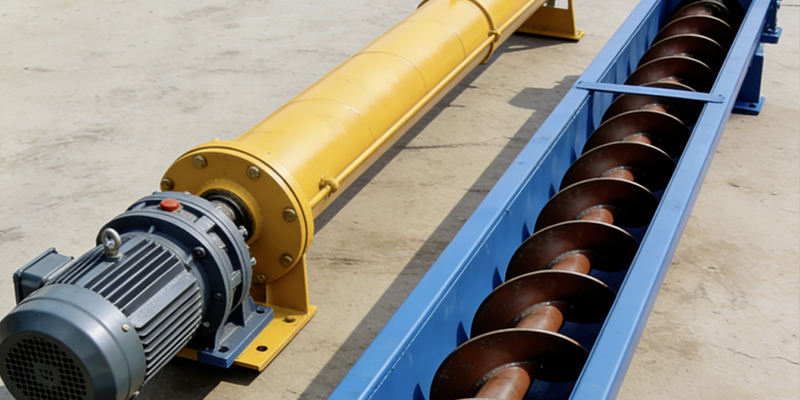
2. How Does a Screw Conveyor Work?
The principle is efficient yet simple: a motor-driven shaft rotates the welded screw blades. As the blades turn, they generate axial thrust on the material.
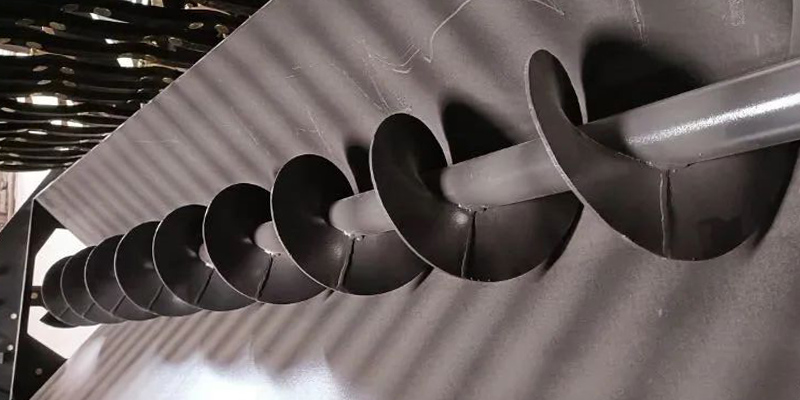
Under the combined force of friction between the material and the blades, and the friction against the cylinder wall, the material moves forward linearly. The quality and precision of the screw pitch and blade thickness directly determine your system’s conveying efficiency and stability.
3. 8 Common Screw Conveyor Blade Failures: Causes & Solutions
① Blade Wear (Abrasive Wear)
Symptoms: Thinned blade edges, reduced outer diameter, and a noticeable drop in conveying capacity.
Causes: Handling high-hardness materials (like sand or minerals) or high-speed rotation without wear-resistant liners.
Manufacturer’s Solution: We recommend overlay welding with wear-resistant electrodes. For high-wear environments, consider upgrading to AR (Abrasion Resistant) steel or thickening the blade edges during the manufacturing phase.
② Blade Deformation and Twisting
Symptoms: Equipment vibration, abnormal noise, and material jamming.
• Causes: Overload feeding or “forced starts” during a material blockage.
• Manufacturer’s Solution: Minor warping can be calibrated. However, if the screw shaft is bent, it must be straightened or replaced to prevent damage to the motor and bearings.
③ Cracking and Fracture
Symptoms: Severe vibration or sudden inability to move material.
Causes: Poor welding quality at the root, or fatigue from frequent forward/reverse cycling.
Manufacturer’s Solution: Use groove welding for minor cracks. At Darko, we ensure high-quality welding and reinforce the blade roots for heavy-duty applications to prevent these fractures.
④ Corrosion, Rust, and Perforation
Symptoms: Pitting or holes in the blade surface.
Causes: Conveying acidic, alkaline, or high-moisture materials using ordinary carbon steel.
Manufacturer’s Solution: Upgrade to 304 or 316L Stainless Steel screw blades. For specialized chemical needs, we also offer anti-corrosion coatings and rubber linings.
⑤ Scratching Against the Cylinder Wall
Symptoms: Metal-on-metal screeching and high operating current (Amps).
Causes: Bent main shaft or sagging hanging bearings.
Manufacturer’s Solution: Re-align the installation and replace worn hanging tiles. Regularly check the concentricity of the shaft to avoid wall friction.
⑥ Material Accumulation and Blockage
Symptoms: Material adhering to the blade surface, leading to stalling.
Causes: High material viscosity (stickiness) or rough blade surfaces.
Manufacturer’s Solution: Polish the blade surface or install cleaning blades (scrapers) to prevent buildup.
⑦ Welding Detachment
Symptoms: The blade separates from the pipe shaft; the shaft spins but the material stays still.
Causes: Excessive force during blockages or poor weld penetration.
Manufacturer’s Solution: Re-weld and reinforce fully. We suggest adding segmented reinforcing ribs for high-torque systems.
⑧ Pitch Deformation (Uneven Feeding)
Symptoms: Fluctuating discharge volume and inconsistent conveying speed.
Causes: Long-term stress or non-standard manufacturing.
Manufacturer’s Solution: Re-calibrate the pitch. Custom-made standard screw blades are the best way to ensure a consistent flow rate.
4. Frequently Asked Questions (FAQ)
How often should I check my screw conveyor blades for wear?
For standard materials, a quarterly inspection is recommended. For abrasive materials like cement or minerals, monthly checks are vital to prevent sudden failure.
Can I replace just one section of the screw blade?
Yes. Sectional screw blades allow for the replacement of specific damaged areas without replacing the entire shaft, saving on maintenance costs.
What is the benefit of Stainless Steel blades vs. Carbon Steel?
Stainless Steel (304/316) offers superior corrosion resistance and is essential for food-grade or chemical applications, whereas Carbon Steel is more cost-effective for dry, non-corrosive bulk solids.
Why Choose Darko for Your Screw Conveyor Needs?
As a professional manufacturer of material handling equipment, Darko provides more than just machinery—we provide solutions. Our screw conveyors are engineered for durability, featuring precision-welded blades and heavy-duty drive systems. Contact us now to optimize your bulk material handling efficiency.
 English
  Russian
  French
  Portuguese
  Arabic
  Spanish
  Japanese