
Dans le domaine du contrôle des poussières industrielles, filtres à manches pour le dépoussiérage sont très efficaces et largement applicables. Ils servent d'équipement de base pour de nombreuses entreprises afin de garantir un environnement de production propre et de respecter les normes d'émission dans l'environnement. Cependant, un contrôle inadéquat du rapport air/toile, en particulier lorsqu'il est trop élevé, entraîne une série de problèmes graves. Ces problèmes ont un impact négatif sur le fonctionnement stable du filtre à manches, sur son efficacité de dépoussiérage, sur la sécurité de la production et sur les bénéfices économiques de l'entreprise.
Problèmes causés par un rapport air/toile trop élevé
Augmentation de l'usure de la poche filtrante
Les manches filtrantes sont les principaux éléments filtrants d'un dépoussiéreur à sacs filtrants. Leur durée de vie affecte directement les coûts d'exploitation et la fréquence d'entretien du dépoussiéreur. Lorsque le rapport air/toile est trop élevé, l'air chargé de poussière percute la surface des manches filtrantes à une vitesse plus élevée. Cela soumet les sacs à des contraintes mécaniques plus importantes. L'impact continu du flux d'air à grande vitesse provoque la rupture des fibres et l'endommagement des manches filtrantes. L'usure est plus prononcée sur le côté exposé au vent et sur la partie inférieure des manches. Un fonctionnement à long terme avec un rapport air/toile élevé accélère considérablement l'endommagement des manches. Cela nécessite non seulement un remplacement fréquent des manches, ce qui augmente les coûts d'exploitation, mais provoque également des fuites de poussières dues à la rupture des manches. Par conséquent, l'efficacité du dépoussiérage et la qualité du milieu environnant s'en trouvent affectées.
Baisse significative de l'efficacité du dépoussiérage
Le principe de dépoussiérage des filtres à manches repose principalement sur des mécanismes tels que l'interception des poussières, la diffusion et la collision inertielle par les manches filtrantes. Un rapport air/toile trop élevé réduit le temps de séjour de l'air chargé de poussières à la surface de la poche. Les particules de poussière n'ont pas assez de temps pour être capturées efficacement par les sacs filtrants. Au lieu de cela, elles passent à travers les sacs avec le flux d'air dans la chambre d'air propre. Cela entraîne une baisse substantielle de l'efficacité du dépoussiérage. La fuite des fines particules de poussière est particulièrement importante lorsque le rapport air/toile est élevé. En conséquence, les concentrations d'émissions peuvent ne pas respecter les normes environnementales. Les entreprises sont alors confrontées à des risques tels que des pénalités environnementales et des restrictions de production.
Défaillances fréquentes du système de nettoyage
Le système de nettoyage est un élément essentiel au maintien du fonctionnement normal d'un filtre à manches. Sa fonction est d'éliminer périodiquement la poussière accumulée à la surface du sac et de restaurer la capacité de filtrage des sacs. Un rapport air/toile excessif accélère le taux d'accumulation du gâteau de poussière sur la surface du sac. Par conséquent, le système de nettoyage doit accomplir sa tâche en un temps plus court. Cela augmente considérablement la charge de travail des dispositifs de nettoyage, tels que les vannes à impulsion et les tuyaux de soufflage. Cela conduit facilement à des défaillances telles que l'endommagement des membranes des vannes d'impulsion ou le colmatage des tuyaux de soufflage. Simultanément, l'efficacité du nettoyage peut être insatisfaisante lorsque le rapport air/toile est élevé. La poussière résiduelle continue d'affecter la perméabilité des sacs. Cela aggrave encore le déclin de l'efficacité du dépoussiérage, créant ainsi un cercle vicieux.
Augmentation substantielle de la consommation d'énergie
Un rapport air/toile excessif augmente la résistance du système du filtre à manches. Pour surmonter cette résistance accrue et maintenir un débit d'air normal, le ventilateur doit consommer davantage d'énergie électrique pour fournir une pression suffisante. Des études pertinentes indiquent que la consommation d'énergie par le ventilateur augmente de manière exponentielle avec chaque augmentation du rapport air/toile. Cela augmente non seulement les coûts d'électricité de l'entreprise, mais va également à l'encontre de la tendance actuelle à la conservation de l'énergie et à la réduction des émissions. Il entrave le chemin de l'entreprise vers un développement vert et durable.
Des risques de sécurité insignifiants
Un rapport air/toile élevé peut entraîner une série de risques pour la sécurité. D'une part, les sacs filtrants usés ou cassés permettent à la poussière de s'infiltrer à l'intérieur de l'équipement. Cette poussière peut se mélanger à l'air et former un nuage de poussière combustible. À partir d'une certaine concentration et d'une source d'inflammation, ce nuage peut facilement provoquer une explosion de poussière. Cet accident constitue une menace sérieuse pour la sécurité de la production et pour la vie et les biens du personnel. D'autre part, les défaillances du système de nettoyage peuvent entraîner une pression interne anormale. Cela affecte la stabilité structurelle du dépoussiéreur et peut même conduire à l'endommagement ou à l'effondrement de l'équipement.
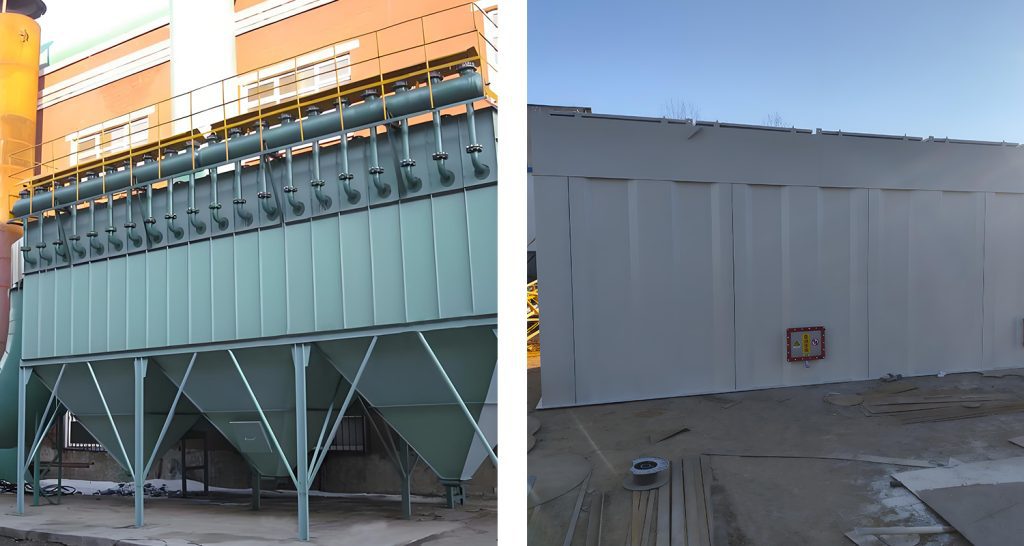
Stratégies de réponse des entreprises
Étant donné les nombreux problèmes causés par des rapports air/toile excessifs, les entreprises utilisant des filtres à manches doivent prendre des mesures efficaces pour contrôler strictement le rapport dans une fourchette raisonnable. Tout d'abord, lors de la phase de conception, le rapport air/toile le plus approprié doit être déterminé par un calcul scientifique et une vérification expérimentale. Cette détermination doit prendre en compte des facteurs tels que les propriétés de la poussière, sa concentration, la distribution de la taille des particules et le volume d'air de traitement. En règle générale, la fourchette raisonnable du rapport air/toile varie selon les industries et les scénarios d'application. Les entreprises doivent se référer aux normes et spécifications pertinentes pour la sélection.
Deuxièmement, il est essentiel de renforcer la surveillance et l'entretien quotidiens des équipements. Les entreprises doivent mettre en place un système complet de contrôle des équipements. Elles doivent tester et analyser régulièrement des paramètres clés tels que le rapport air/toile, la résistance du système et l'efficacité du nettoyage. Cela permet de détecter rapidement les augmentations anormales du rapport air/toile et de procéder à des ajustements correctifs. Parallèlement, il convient d'élaborer un plan d'entretien détaillé de l'équipement. Ce plan comprend l'inspection régulière et le remplacement des sacs filtrants, ainsi que le nettoyage et la réparation du système de nettoyage. Ces étapes garantissent le fonctionnement normal de tous les composants de l'équipement.
En outre, les entreprises devraient améliorer la formation et la gestion des opérateurs. Cela leur permet de mieux comprendre les principes de fonctionnement et les procédures standard des filtres à manches. Cela permet d'éviter la perte de contrôle du rapport air/toile en raison d'une mauvaise utilisation humaine. En mettant en œuvre les mesures globales susmentionnées, les entreprises peuvent garantir un fonctionnement stable et efficace des dépoussiéreurs à sacs filtrants. Il s'agit d'une situation gagnant-gagnant, tant sur le plan économique qu'environnemental.
En résumé, le rapport air/toile est un paramètre de contrôle essentiel pendant le fonctionnement d'un dépoussiéreur à sacs filtrants. Les entreprises doivent accorder une grande attention à son contrôle. Grâce à une conception scientifique, à une surveillance stricte et à une maintenance minutieuse, elles peuvent s'assurer que le filtre à manches fonctionne de manière sûre et efficace. Cela contribue positivement au développement durable de l'entreprise et à la protection de l'environnement.
 English
  Russian
  French
  Portuguese
  Arabic
  Spanish
  Japanese