
Dans le domaine de la manutention de matériaux en vrac, la gestion du flux de poudres, de granulés et de pastilles nécessite une ingénierie de précision. Si les vannes de régulation de débit standard — telles que les vannes à tiroir et les vannes papillon — excellent dans les tâches d'isolation et d'ouverture/fermeture de base, de nombreux procédés industriels exigent des performances supérieures à celles de ces vannes conventionnelles.
Lorsque votre système nécessite un dosage volumétrique continu associé à des capacités d'étanchéité à la pression fiables, les solutions de vannes classiques ne suffisent pas. C'est là que la vanne rotative (communément appelée vanne rotative à sas ou doseur rotatif, parfois simplement désignée sous le nom de vanne rotative) devient un élément indispensable.
Dans ce guide technique, nous passons en revue les principaux types de vannes rotatives et leurs applications concrètes dans des secteurs à forte demande, notamment la fabrication de ciment, l'exploitation minière et le traitement des poudres, afin d'aider les ingénieurs à choisir le modèle de vanne rotative qui répondra exactement aux exigences de leurs procédés.
Qu'est-ce qu'un portail pivotant ?
A portail pivotant Il s'agit d'un composant mécanique conçu pour décharger en continu des solides en vrac tout en maintenant des différences de pression stables entre les zones de traitement distinctes.
Contrairement aux vannes à débit linéaire qui ouvrent ou bloquent entièrement le passage du produit, une vanne rotative est composée d'un rotor à ailettes multiples tournant à l'intérieur d'un boîtier cylindrique usiné avec précision. À mesure que le rotor tourne, les cavités situées entre les ailettes se remplissent de matière première par l'entrée supérieure et se vident par la sortie inférieure sous l'effet de la gravité.
Pour les ingénieurs en conception industrielle, les alimentateurs rotatifs remplissent simultanément deux fonctions essentielles :
- Contrôle des flux de matières: Permet un débit volumétrique réglable, régulé par la vitesse de rotation du rotor (tr/min).
- Joint d'étanchéité pour sas: Limite les fuites croisées d'air ou de gaz de procédé entre des équipements fonctionnant à des pressions différentes (par exemple, entre des trémies de stockage à pression atmosphérique et des conduites de transport pneumatique à haute pression).
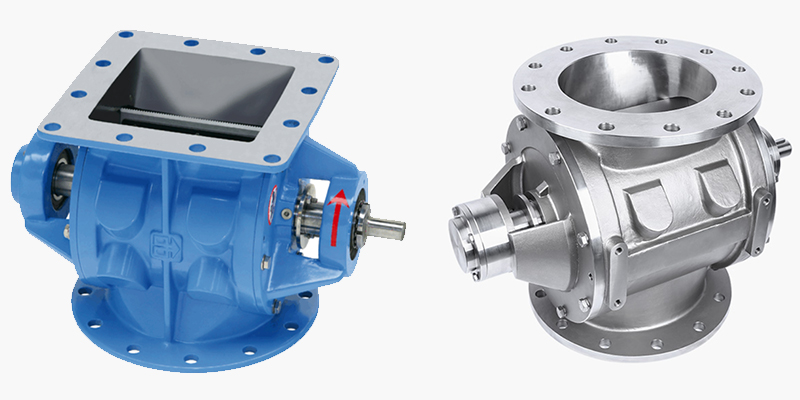
Principaux types de portails pivotants : Ingénierie et architecture
Toutes les conceptions de vannes rotatives ne sont pas conçues pour des conditions de fonctionnement identiques. En tant que fabricant expérimenté de vannes de régulation de débit, nous classons les configurations courantes de vannes rotatives en quatre catégories principales, en fonction de leur conception structurelle et de leurs caractéristiques de manutention des matériaux, comme indiqué ci-dessous.
1. Vannes rotatives à passage direct
Le modèle à déversement par le bas est le type le plus couramment utilisé dans le domaine de la manutention de vrac en général. La matière première pénètre par l'entrée supérieure, remplit les cavités du rotor, puis s'écoule verticalement par la sortie inférieure sous l'effet de la seule force de gravité.
Meilleur pour: Poudres sèches fluides et non agglomérantes ainsi que produits granulaires tels que le ciment prêt à l'emploi, la chaux vive et les cendres volantes.
Conseil technique: Étant donné que l'évacuation dépend entièrement de la gravité, l'efficacité de remplissage des poches doit être calculée en fonction des propriétés d'écoulement du matériau afin d'éviter la formation de ponts de matériau à l'intérieur du corps de la vanne.
2. Vannes rotatives à passage direct
Sur les vannes rotatives à soufflage, la conduite de transport pneumatique traverse directement le corps inférieur de la vanne. L'air de transport à grande vitesse balaye les alvéoles remplies du rotor et propulse les matériaux directement dans la conduite de transport.
Meilleur pour: Matériaux collants, agglomérants ou très aérés qui ont tendance à rester coincés dans les alvéoles des rotors standard.
Avantage principal: Réduit considérablement l'espace libre vertical nécessaire à l'installation, ce qui en fait la solution idéale pour la modernisation de lignes de production existantes disposant d'un espace au sol limité.
3. Portails rotatifs robustes et résistants à l'usure
Les vannes rotatives standard en fonte ou en acier au carbone subissent une érosion accélérée lors du traitement de matières premières hautement abrasives, ce qui entraîne des fuites d'air excessives et des arrêts prématurés du système. Les modèles à usage intensif sont équipés de revêtements intérieurs résistants à l'usure (plaques AR résistantes à l'abrasion, revêtement en carbure de tungstène ou manchons en céramique remplaçables) ainsi que de structures de pointes de rotor personnalisables.
Meilleur pour: Clinker de ciment, minerai concassé, sable siliceux et autres minéraux abrasifs à arêtes vives.
Caractéristique principale: On utilise généralement une construction à rotor fermé pour protéger les plaques d'extrémité et les roulements contre tout contact abrasif direct avec les solides en vrac entrants.
4. Portails rotatifs hygiéniques et à nettoyage rapide
Conçues pour les secteurs soumis à des réglementations strictes en matière d'hygiène et de prévention de la contamination croisée, les vannes rotatives sanitaires à nettoyage rapide sont dotées d'un rotor coulissant. Les opérateurs peuvent extraire l'ensemble du rotor le long des rails de guidage intégrés sans avoir à déconnecter le corps de la vanne de la tuyauterie raccordée.
Meilleur pour: Transformation alimentaire (sucre en poudre, farine de blé, produits laitiers en poudre), production pharmaceutique et fabrication de produits chimiques de spécialité.
Applications industrielles : où déployer quel type ?
Le choix d'une vanne rotative adaptée permet d'améliorer la disponibilité de l'installation et de réduire l'usure prématurée des composants. Vous trouverez ci-dessous des exemples d'installations courantes dans des environnements industriels lourds :
Systèmes de dépoussiérage et séparateurs à cyclone
Les vannes rotatives font partie de l'équipement standard installé sous les trémies de déchargement des filtres à manches et des séparateurs à cyclone dans les systèmes industriels de dépoussiérage.
Rôle de l'application: Le sas rotatif évacue en continu la poussière collectée vers les équipements de transport en aval, tout en empêchant l'air ambiant d'être aspiré vers le haut dans les trémies à dépression.
Une importance cruciale: Les fuites d'air provenant de vannes rotatives défectueuses perturbent le tourbillon interne du cyclone et rompent l'équilibre de pression du filtre à manches, ce qui réduit considérablement l'efficacité de la dépoussiérage et entraîne des infractions aux normes environnementales sur le site.
Systèmes de transport pneumatique (à pression positive et à pression négative)
Que ce soit dans le cadre d'un transport par poussée en surpression ou d'un transport par aspiration sous vide, les vannes rotatives à sas servent de points de régulation de l'alimentation des conduites.
Rôle de l'application: Ils dosent des produits en vrac dans un flux d'air de transport à grande vitesse, à un débit d'alimentation stable et réglable.
Une importance cruciale: Une suralimentation entraîne des obstructions dans les conduites et des arrêts imprévus coûteux ; des vannes rotatives correctement dimensionnées permettent de maintenir des rapports de mélange air-matière solide optimaux pour un transport sans heurts.
Alimentation en vrac à partir de silos et de trémies
Les silos de stockage de grande capacité, tels que ceux destinés à la farine de céréales ou au ciment Portland ordinaire (OPC), nécessitent des équipements de déchargement précis pour alimenter les stations de pesage en aval ou les systèmes de chargement des camions-citernes.
Rôle de l'application: Équipés de moteurs à variateur de fréquence (VFD), ces vannes rotatives à usage intensif régulent le déversement par gravité directement sous les fonds de fluidisation des silos ou les sorties des trémies coniques, en adaptant de manière flexible le débit d'alimentation aux variations du débit de production.
Tableau de référence pour le choix des portails battants
| Type de portail | Fonction principale | Meilleur matériau pour l'application et le traitement |
|---|---|---|
| Drop-Through | Alimentation volumétrique par gravité + sas à pression | Poudres à écoulement libre : ciment, cendres volantes, chaux |
| Soufflage | Système d'alimentation pneumatique en ligne à haut rendement et peu encombrant | Poudres fines collantes / sites où l'espace libre en hauteur est limité |
| À usage intensif / Résistant à l'usure | Alimentation volumétrique et étanchéité résistantes à l'abrasion | Scories, clinker, agglomérés, minerais bruts et minéraux abrasifs coupants |
| Nettoyage rapide / Hygiène | Une alimentation hygiénique sans aucun risque de contamination croisée | Agroalimentaire, chimie fine, matières premières pharmaceutiques (changements fréquents de produits) |
Facteurs déterminants dans le choix d'une solution d'ingénierie
Des spécifications inadéquates peuvent entraîner des problèmes de fonctionnement courants, notamment le grippage du rotor, la surcharge du moteur et des fuites d'air excessives. Nous vous recommandons de collaborer avec votre équipe d'ingénieurs interne ou avec un fabricant de vannes de régulation de débit de confiance afin d'évaluer ces paramètres clés avant l'achat :
- Jeu au niveau de l'extrémité du rotor: L'écart entre les extrémités des pales du rotor et le boîtier fixe de la vanne. Un jeu serré de 0,1 mm assure une excellente étanchéité pour les matériaux non abrasifs à température ambiante. Ce jeu doit être augmenté en cas d'utilisation à haute température (par exemple, pour la manutention de cendres chaudes) afin de tenir compte de la dilatation thermique du métal.
- Rendement de remplissage des poches: Ne calculez jamais le dimensionnement de la vanne en vous basant sur la capacité de remplissage de la poche de 100%. Dans des conditions réelles de fonctionnement par gravité, le débit de remplissage réel de la poche varie seulement entre 50% et 70%. Le fait de surdimensionner légèrement la vanne rotative et de la faire fonctionner à un régime réduit prolonge considérablement sa durée de vie.
- Pression différentielle nominale: Les vannes rotatives standard supportent une pression différentielle allant jusqu'à 15 PSI. Les processus dépassant cette valeur nominale nécessitent une construction renforcée et robuste afin d'empêcher les gaz de fuite de repousser la matière première fine vers les silos de stockage en amont.
Conclusion
Le choix d'un clapet rotatif adapté constitue une décision technique stratégique qui améliore directement le rendement global de l'installation, réduit la fréquence des interventions de maintenance et optimise l'efficacité du confinement des poussières.
En tant que partenaire de confiance pour le transport industriel de matériaux en vrac, Darko est spécialisé dans la fabrication de vannes de régulation de débit robustes et résistantes à l'usure, conçues pour résister aux conditions d'exploitation les plus difficiles sur le terrain. Contactez dès aujourd'hui notre équipe d'ingénieurs techniques pour obtenir des plans CAO sur mesure, des fiches techniques d'équipement ou des conseils personnalisés pour votre prochain projet de conception.
 English
  Russian
  French
  Portuguese
  Arabic
  Spanish
  Japanese