
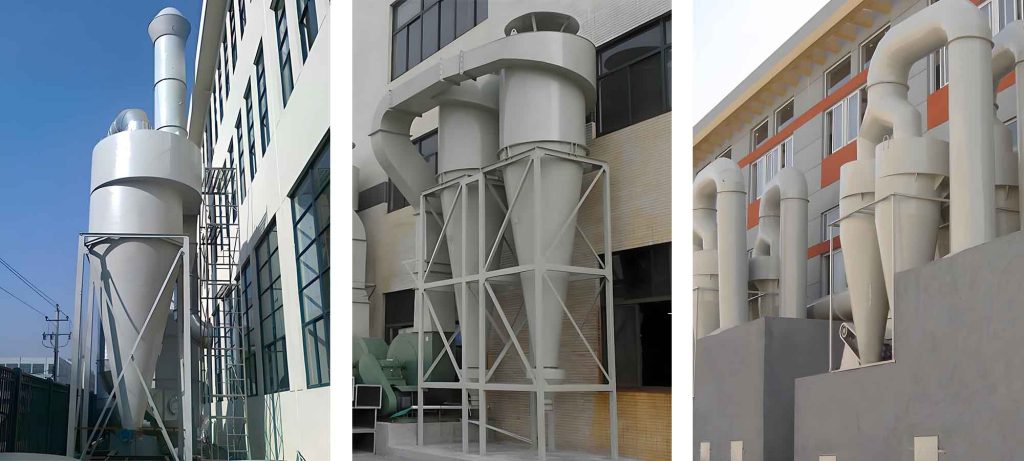
Qu'est-ce qu'un séparateur cyclonique ?
Un séparateur à cyclone est un dispositif de séparation industriel qui élimine les particules solides, la poussière, les débris et les gouttelettes de liquide des flux gazeux grâce à la force centrifuge et à la gravité. Il constitue un équipement essentiel pour la séparation gaz-solides dans le secteur industriel.
Contrairement aux filtres à manches et aux précipitateurs électrostatiques (ESP), un dépoussiéreur à cyclone ne comporte aucune pièce mobile ni aucun consommable de filtration et n'est pas sujet au colmatage. Il peut fonctionner de manière stable dans des conditions de travail caractérisées par des températures élevées, une forte concentration en poussière et une usure importante, ce qui le rend idéal pour les applications industrielles de prétraitement, de préfiltration et de récupération de poudre.
Composants fondamentaux et physique technique
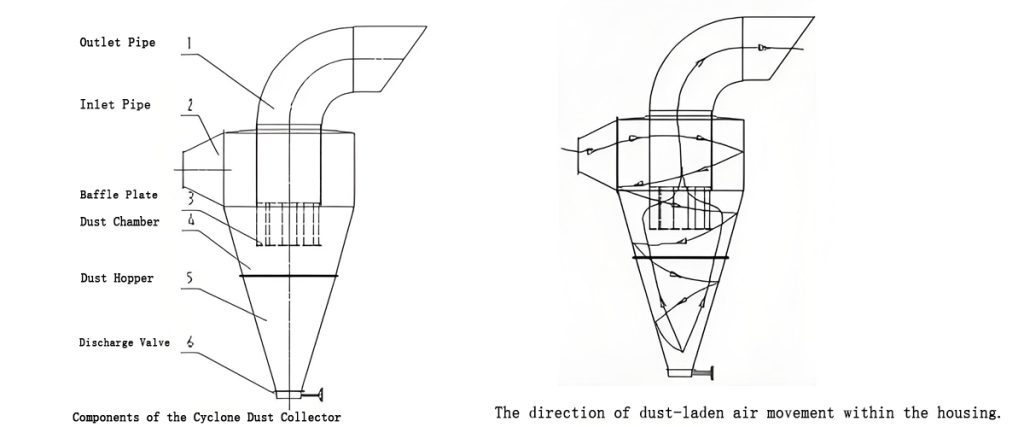
Les performances d'un cyclone dépendent fortement de la géométrie de ses composants principaux. La compréhension de ces composants aide les ingénieurs à diagnostiquer les baisses de rendement, l'usure du système et les problèmes de perte de pression :
- Entrée tangentielle: Il transforme un écoulement linéaire de gaz en un flux d'air tourbillonnant à grande vitesse, créant ainsi le champ centrifuge stable nécessaire à une séparation précise des particules.
- Corps cylindrique: Stabilise le tourbillon externe et assure la séparation initiale des particules grossières et lourdes du flux gazeux.
- Section conique: Réduit progressivement le rayon de rotation du flux d'air, ce qui force la poussière à descendre tout en accélérant la vitesse du vortex afin de capturer les particules les plus fines.
- Vortex Finder (sortie centrale de gaz): Il s'étend vers le bas à l'intérieur du cylindre afin d'empêcher tout court-circuit de gaz impur, garantissant ainsi que seul l'air purifié du vortex interne quitte le système.
- Trémie à poussière: Permet de collecter la poussière déposée à la base en vue d'un évacuation centralisée ou de la récupération des matières valorisables. Une étanchéité parfaite est essentielle pour éviter toute perte d'efficacité.
Principe de fonctionnement : les mécanismes de la séparation centrifuge
Le principe de fonctionnement du séparateur cyclonique repose entièrement sur la séparation centrifuge par tourbillonnement. L'ensemble du processus ne nécessite aucune pièce mobile à entraînement électrique et fonctionne uniquement grâce à l'énergie cinétique du flux d'air :
- Prise d'air tangentielle à grande vitesse: Le gaz chargé de poussière pénètre dans la chambre du cyclone à une vitesse précise comprise entre 18 et 25 m/s, formant ainsi un vortex externe descendant à grande vitesse le long de la paroi interne.
- Séparation centrifuge des particules: Les particules de poussière présentes dans le flux d'air sont soumises à une force centrifuge de 500 à 2 000 fois supérieure à la force de gravité, ce qui les pousse vers l'extérieur, en direction de la paroi du cyclone.
- Décantation par gravité et dépoussiérage: Lorsque les particules heurtent la paroi intérieure, elles perdent de leur énergie cinétique, glissent le long de la partie conique et se déposent dans la trémie à poussière située au fond.
- Décharge de gaz pur: Lorsque la colonne d'air en rotation atteint le fond, elle change de direction, formant un vortex interne ascendant bien défini qui s'échappe par le capteur de vortex central.
Indicateur clé de performance : Comprendre le diamètre de coupure D50
- Cyclones standard: Convient particulièrement aux poussières moyennes et grossières supérieures à 10 μm, idéal pour un dépoussiérage préliminaire général, avec un diamètre de coupure D50 typique compris entre 10 et 20 μm.
- Cyclones à haut rendement: Retient de manière fiable les particules fines comprises entre 4 et 7 μm, ce qui permet de respecter les normes d'émissions industrielles les plus strictes, avec un diamètre de coupure D50 pouvant descendre jusqu'à 4 μm.
La règle du préfiltre pour un retour sur investissement maximal : si vos normes locales en matière d’émissions exigent un contrôle des poussières ultrafines (limites pour les PM2,5 et les particules inférieures à 10 μm), considérez le cyclone comme un pré-séparateur à forte charge. En éliminant jusqu’à 90% de poussières lourdes et de particules grossières abrasives avant qu’elles n’atteignent les filtres à manches en aval, vous pouvez prolonger la durée de vie des manches filtrantes de 300% à 400%, ce qui réduit considérablement les coûts de remplacement et les arrêts de production imprévus.
Relever les défis liés à l'abrasion dans les secteurs du ciment et des mines
Dans les industries lourdes telles que la production de ciment, l'exploitation minière et le traitement des granulats, les séparateurs à cyclone traitent des matériaux hautement abrasifs, notamment le clinker de silice, le quartz, le calcaire et les minerais métalliques. À des vitesses d'entrée élevées, ces particules agissent comme du papier de verre, usant les enveloppes standard en acier au carbone en moins de six mois.
Le choix d'un matériau de revêtement adapté détermine directement la durée de vie, la fréquence d'entretien et le coût total de possession (TCO).
Comparaison des performances des matériaux de revêtement résistants à l'usure
Matériau de revêtement | Dureté (Mohs / HRC) | Indice de durée de vie | Scénarios d'application idéaux |
|---|---|---|---|
Acier au carbone standard | environ 150 HB | 1x (référence) | Collecte de poussière non abrasive, pour usage léger |
Acier Hardox / AR400 | 40 à 50 HRC | 3x – 4x | Minéraux à abrasivité moyenne, traitement des granulats |
Fonte à haute teneur en chrome | 55 à 62 HRC | 6x – 8x | Zones soumises à de forts chocs : entrée et partie conique supérieure |
Céramique d'alumine 92%/95% | 9 sur l'échelle de Mohs | 15x – 20x | Clinker de ciment, quartz, poussières fines extrêmement abrasives |
Pourquoi le revêtement céramique à base d'alumine est-il la référence absolue dans le secteur ?
- Dureté extrême: Une dureté de 9 sur l'échelle de Mohs offre une résistance supérieure à l'abrasion minérale et à l'érosion par les poussières abrasives.
- Aucun entretien régulier: Les unités à revêtement céramique ont une durée de vie de 3 à 5 ans sans qu'il soit nécessaire de procéder à des réparations ponctuelles ou de remplacer la coque, ce qui permet d'éliminer les coûts liés aux réparations récurrentes.
- Haute stabilité thermique: Contrairement aux revêtements en caoutchouc qui se dégradent ou fondent à des températures supérieures à 200 °C, les carreaux de céramique collés à l'aide d'adhésifs inorganiques résistants aux hautes températures conservent leur stabilité structurelle jusqu'à 500 °C, ce qui leur permet de s'adapter à la plupart des environnements industriels exposés à des gaz de combustion à haute température.
Exemple concret de retour sur investissement dans l'industrie : défaillance au bout de 6 mois contre durée de vie de 5 ans
Types courants de séparateurs à cyclone
1. Séparateur à cyclone simple
2. Séparateur multicyclonique (Multiclone)
3. Séparateur à cyclone à haut rendement
4. Séparateur cyclonique à faible perte de charge
3 raisons cachées pour lesquelles votre Cyclone perd en efficacité (Guide de dépannage de l'ingénieur)
- Les fuites d'air (le tueur silencieux): Une simple fuite d'air de 51 TP3T au niveau de la trémie à poussière ou de la vanne de décharge réduit le rendement de 101 TP3T à 201 TP3T. Les courants d'air ascendants entraînent à nouveau la poussière déposée dans les gaz d'échappement propres. Veillez à ce que les vannes rotatives d'étanchéité soient toujours parfaitement étanches.
- Vitesse d'entrée déséquilibrée: Une vitesse maintenue en dessous de 18 m/s ne permet pas de générer une force centrifuge suffisante pour séparer les fines particules de poussière ; une vitesse constamment supérieure à 25 m/s entraîne une turbulence excessive du flux d'air, une remise en suspension des particules et un gaspillage d'énergie inutile du ventilateur, ces deux phénomènes conduisant à une diminution de l'efficacité globale de la séparation.
- Débordement de la trémie: Des amas de poussière trop importants entravent l'inversion du vortex de fond, ce qui entraîne le réaspiration de la poussière déposée dans la cheminée d'évacuation et réduit considérablement les performances de purification.
Comparaison technique : séparateur à cyclone, filtre à manches et précipitateur électrostatique (ESP)
Élément de comparaison | Séparateur cyclonique | Précipitateur électrostatique (ESP) | |
|---|---|---|---|
Taille des particules concernée | 2,5 à 100 μm | 0,1 à 100 μm | 0,01 à 100 µm |
Efficacité d'élimination | 50% – 99% | 95% – 99.9% | 90% – 99.9% |
Besoins en consommables | Pas de consommables | Remplacement périodique des sacs filtrants | Entretien des électrodes Rare |
Coûts d'exploitation et de maintenance | Extrêmement faible | Élevé (coûts de main-d'œuvre + coûts des filtres) | Moyen |
Coût initial de l'équipement | Faible | Moyen | Haut |
Surface au sol | Compact et peu encombrant | Grande surface au sol | Une très grande empreinte écologique |
Meilleure candidature | Dépoussiérage préliminaire, poussières abrasives, récupération des matières, gaz de combustion à haute température | Poussières fines, respect rigoureux des normes d'émissions | Systèmes de centrales électriques à très grand débit d'air |
Comment choisir le séparateur à cyclone adapté (liste de contrôle technique étape par étape)
- Vérifier les caractéristiques de la poussière: Analysez la distribution granulométrique (PSD), la concentration en poussière, l'humidité et l'abrasivité. Optez pour des modèles standard pour les poussières grossières, des modèles à haute efficacité pour les poussières fines et des modèles à revêtement en céramique pour les poussières minérales abrasives.
- Vérifier le débit d'air réel: Calculez le volume de gaz réel aux conditions de température et de pression sur site afin d'adapter avec précision les configurations à cyclone unique ou à cyclones multiples.
- Préciser les objectifs en matière d'émissions: Utilisez des cyclones pour une pré-séparation économique ; associez-les à des filtres à manches en aval si des normes strictes en matière d'émissions de particules ultrafines s'appliquent.
- S'adapter à l'environnement d'exploitation: Choisissez des structures résistantes aux hautes températures pour les gaz de combustion chauds et des modèles en acier inoxydable résistants à la corrosion pour les gaz industriels corrosifs.
 English
  Russian
  French
  Portuguese
  Arabic
  Spanish
  Japanese