
For dust control in cement plants, one of the core decisions is selecting between cyclones and bag filters. While both capture dust, their working principles differ greatly. A poor selection can lead to excess energy consumption, non‑compliant emissions, or frequent system clogging.
This side‑by‑side comparison outlines their respective strengths to help you select the right solution for your actual operating conditions.
The Short Answer
Use a cyclone when you need simple, low‑cost pre‑separation of coarse, heavy dust. Use a bag filter (baghouse) when you need to meet strict emission limits — typically below 20–30 mg/Nm³ — and capture fine dust.
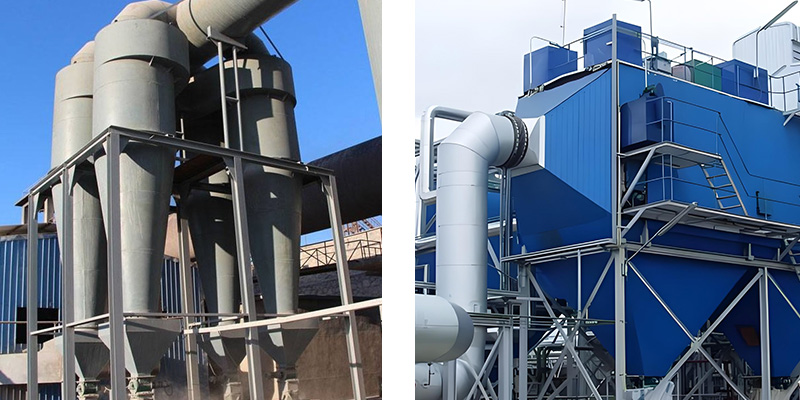
How Cyclones and Bag Filters Work
Understanding the working principle of cyclone separators and bag filters helps avoid wrong selection.
A cyclone dust collector relies on centrifugal force. High-speed dusty air enters tangentially, spins inside the cylinder. Heavy coarse dust particles are thrown outward against the wall, slide down and get collected at the bottom hopper. Fine dust remains in the airflow and exits with the gas. No filter media is involved in this physical separation process.
A pulse-jet bag filter works by surface filtration. Dust-laden gas passes through woven or felt filter bags. Fine particles stick on the outer surface of filter media, while clean air penetrates through the bag. Periodic compressed air pulse blows off accumulated dust cake into the hopper, regenerating the filter surface continuously.
Cyclone vs Bag Filter: Key Differences
| Facteur | Dépoussiéreur cyclonique | Bag filter (baghouse) |
|---|---|---|
| Efficacité | 70‑95 %, performance drops significantly with fine dust | 99.9 %+, capable of capturing ultra‑fine particles |
| Emissions | Hard to satisfy modern emission standards when used standalone | Consistently achieves single‑digit mg/Nm³ emission levels |
| Coût | Low capital investment | Higher capital expenditure |
| Maintenance | Simple design with few moving parts; minimal routine maintenance | Periodic bag replacement and regular cleaning required |
| Space | Empreinte compacte | Requires larger installation space |
| Best use | Pre‑separation, coarse‑dust removal | Final filtration, fine‑dust abatement |
Pros & Cons Overview
Cyclone Dust Collector: Advantages and Disadvantages
✅ Advantages
- Simple mechanical structure, low upfront cost
- No consumable filter bags, low running cost for coarse dust removal
- Can withstand relatively high inlet temperature
- Serve as effective pre-separator to reduce dust burden on downstream equipment
❌ Limitations
- Poor collection efficiency for fine particles below 10μm
- Severe abrasion risk when handling abrasive cement raw meal and clinker dust
- Collection performance heavily affected by airflow fluctuation and dust density
- Cannot meet strict low-emission requirements independently
Pulse Jet Baghouse: Advantages and Disadvantages
✅ Advantages
- Extremely high capture efficiency for fine and ultra-fine dust
- Stable outlet concentration under variable working load
- Suitable for hazardous dust and valuable dust recovery
- Mature technology widely adopted in modern cement kilns, mills and coolers
❌ Limitations
- Higher initial investment and recurring cost from filter bag replacement
- Risk of bag blinding when processing high-moisture or sticky dust
- Filter bags have temperature limits; overheating will cause bag damage
- Requires regular inspection of compressed air system and bag condition
When to Choose a Cyclone
A cyclone is a centrifugal separator without filter media. It features low cost and mechanical simplicity with minimal routine maintenance. It performs well as a first‑stage unit upstream of a bag filter, removing coarse particles to reduce dust loading on filter bags.
Choose a cyclone when:
- You process coarse, heavy dust (e.g. primary crushing) and fine‑particle capture is not required
- You need a low‑cost pre‑separator to protect downstream baghouse equipment
- Installation space and project budget are constrained
Note: Cyclones are subject to abrasive wear in cement service and still require periodic inspection of linings and shell components.
When to Choose a Bag Filter
A pulse‑jet baghouse forces dust‑laden air through filter bags to trap fine particulates. Compressed air pulses periodically clean the filter media to sustain performance.
Choose a bag filter when:
- You must comply with stringent emission standards, the common requirement for modern cement kilns, coolers and mills
- You handle fine, hazardous or high‑value dust that cannot be released into the atmosphere
- Stable low emissions are required across the full operating range of your facility
For most cement plants, the optimal solution combines both technologies: a cyclone pre‑separator followed by a bag filter. This arrangement balances capital cost and regulatory compliance.
FAQ
Q: Which is better, a bag filter or a cyclone?
Performance depends on your application. Bag filters deliver far lower emissions, while cyclones offer lower cost and simpler operation. Many cement facilities deploy cyclones for pre‑separation upstream of bag filters.
Q: Can a cyclone meet emission limits on its own?
Usually not. Cyclones efficiently remove coarse dust but have limited capture for fine particles, so they can rarely meet modern emission requirements when operating alone.
Why install a cyclone before a bag filter?
The cyclone removes coarse dust upfront. This reduces dust load on the bag filter, extends bag service life and lowers the frequency of cleaning cycles.
Q: What operating constraints apply to bag filters?
High temperature, elevated moisture and sticky dust may cause bag degradation or media blinding. Special filter media must be selected for these challenging conditions.
Looking for a dust control solution tailored to your cement plant? Contact Darko for custom‑sized cyclone and baghouse packages designed to match your site conditions and emission targets.
 English
  Russian
  French
  Portuguese
  Arabic
  Spanish
  Japanese