
When a screw conveyor suffers sudden blockage within a power plant coal handling circuit, site maintenance teams often land on one quick explanation: the coal is too wet.
It is true that high coal moisture alters bulk material flow behavior and raises clogging risk. Still, if your screw conveyor keeps jamming repeatedly, forcing unplanned shutdowns and manual cleanouts, wet coal is seldom the root cause of persistent screw conveyor blockage.
Stable screw conveyor performance relies on a balanced combination of bulk material properties, feeding configuration, screw geometry, installation inclination and discharge conditions working together.
For power stations, an isolated clog is just a minor operational incident. But if your system falls into a continuous loop of screw conveyor clogging → shutdown → manual clearing → restart, you need to evaluate a critical question:
- Is your coal handling screw conveyor properly engineered for your actual site operating conditions?
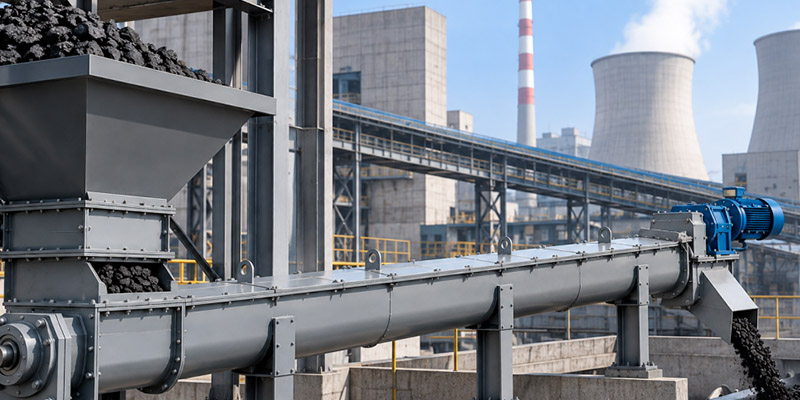
1. Wet Coal Is Typically Only a Trigger for Screw Conveyor Blockage
Rising moisture content makes coal sticky, changes flowability and encourages agglomeration. Loose coal clings to screw flights and trough liners, creating dead zones where material slowly builds up. Once accumulation starts, incoming coal stacks on top until a full blockage forms.
Wet coal definitely increases the chance of screw conveyor clogging, yet incoming coal quality at power plants always fluctuates.
If your screw conveyor operates reliably only under ideal coal conditions and clogs every time coal becomes sticky, the unit lacks sufficient robustness for real-world coal handling.
This is why specifying a screw conveyor for coal service requires more than simply telling your supplier “we convey coal.” You need to share details such as coal particle sizing, gangue content, typical moisture bands and inherent stickiness.
2. Mismatched Infeed and Discharge Layouts Drive Progressive Screw Conveyor Clogging
Most purchasers focus almost exclusively on one specification: hourly tonnage throughput.
Two equally critical design considerations frequently get overlooked:
- How does upstream equipment feed the screw conveyor?
- Can downstream receiving equipment evacuate material at the same rate?
Surge feeding or intermittent heavy inflow overwhelms conveying capacity. Material piles at the inlet section, increases trough fill level and spikes running torque.
On the other hand, the screw may keep advancing coal forward while the discharge chute or downstream transfer point cannot keep pace. This backpressure leads to buildup near the outlet and eventually screw conveyor blockage.
Effective screw conveyor troubleshooting cannot examine the screw unit in isolation. You must assess the complete material flow sequence:
Upstream feeding → Screw conveying → Downstream discharge & receiving
3. Screw Pitch, Rotational Speed and Inclination Require Custom Matching
A screw conveyor may look mechanically simple, but screw diameter, flight pitch and operating speed must be carefully calibrated as a set.
The feed zone is especially sensitive. Poor alignment between feed rate, screw pitch and rotational speed creates localized overfilling. Fresh coal continues entering while existing material cannot progress downstream, which significantly elevates clogging risk.
When you run an inclined screw conveyor, gravity further restricts material movement. Horizontal screw conveyor design parameters cannot be copied directly for inclined installations.
That explains why two visually identical standard screw conveyors can deliver drastically different reliability once deployed across different power plant coal handling sites.
4. Screw Conveyor Motor Overload Does Not Automatically Mean You Need a Larger Motor
When facing repeated clogging, binding or sustained screw conveyor motor overload, maintenance teams often assume the drive motor is undersized.
Blockage, however, is not equivalent to insufficient motor power.
If the underlying issue stems from surge feeding, poorly matched screw geometry or restricted discharge, upgrading to a larger motor will not fix material accumulation. Persistent abnormal load continues to fatigue the main shaft, flights, bearings and gearbox, raising the risk of catastrophic component failure.
The correct screw conveyor troubleshooting workflow follows this order:
- Pinpoint the exact location where blockage occurs
- Diagnose why material cannot flow freely
- Select corrective actions: adjust pitch, speed, inlet geometry, discharge layout or other design features
5. Custom Screw Conveyor Design Built Around Your Coal Handling Operating Conditions
Darko delivers custom-engineered screw conveyors tailored specifically for power plant coal handling applications.
Before finalizing a proposal, our engineering team reviews all site variables:
- Bulk coal characteristics
- Required design throughput
- Conveying length
- Installation inclination angle
- Inlet and discharge configuration
- Operating duty cycle
- Existing recurring blockage and overload issues
Based on these data points, we select optimized screw diameter, flight pitch, trough profile, flight material, shaft construction and drive assembly.
Our philosophy avoids forcing standard catalogue screw conveyors onto every power plant. Our core principle is straightforward: assess site conditions first, then engineer equipment that adapts to your bulk material.
Wrap-Up
Frequent power plant screw conveyor clogging within coal handling lines is rarely caused by wet coal alone. Reliability hinges on whether material behavior, feeding, conveying, discharge and screw geometry function as a harmonized system.
If your site struggles with inlet coal buildup, wet-coal clogging, persistent screw conveyor motor overload, frequent shutdowns for clearing or unstable inclined conveying performance, send us your project details: bulk material type, required capacity, conveying length, installation angle and the primary location where blockage happens.
Darko can engineer tailored screw geometry, flight pitch, wear-resistant flight materials, feed/discharge modifications and drive packages for your coal handling circuit.
Resolving screw conveyor blockage is not about blindly upsizing equipment. It means designing a flow system where coal can feed consistently, transport reliably and discharge unobstructed.
FAQ
Why does a screw conveyor keep clogging with wet coal in power plants?
Wet coal increases cohesion and sticking, but recurring screw conveyor blockage usually comes from mismatched feed rates, inadequate discharge capacity or poorly matched screw pitch and speed, rather than moisture alone.
Can I use a horizontal screw conveyor design for inclined coal conveying?
No. Gravity slows material movement in inclined screw conveyors. Pitch, fill factor and speed must be adjusted; standard horizontal designs often lead to frequent clogging.
Should I upgrade the motor size if my screw conveyor overloads during blockage?
Not as a first step. Screw conveyor motor overload is often a symptom of poor material flow. You need to troubleshoot blockage locations and flow restrictions before changing the drive.
What details are needed for custom screw conveyor design for coal handling?
Key parameters include coal properties, throughput, conveying length, inclination angle, inlet/discharge layout, operating cycle and common blockage zones.
How do you troubleshoot repeated screw conveyor clogging in coal handling systems?
Start by identifying the blockage location, then check for surge feeding, discharge restrictions, improper screw pitch, excessive fill rate or incompatible inclined installation parameters.
What is the difference between standard and custom screw conveyors for power plants?
Standard screw conveyors are built for general-purpose conveying, while custom screw conveyors are calibrated for your coal properties, throughput, inclination and feed/discharge arrangement to reduce clogging and overload.
Need Custom Screw Conveyor Troubleshooting & Design for Your Coal Handling System?
Contact Darko’s engineering team to discuss your recurring screw conveyor clogging challenges and get a custom screw conveyor solution for your power plant.
 English
 Russian
 French
 Portuguese
 Arabic
 Spanish
 Japanese