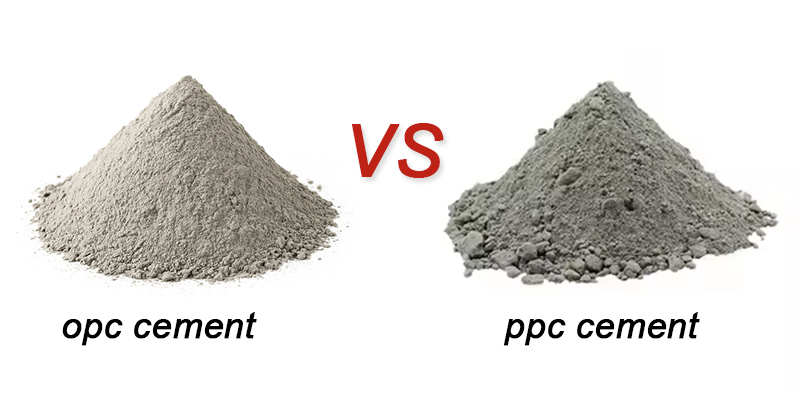
In the construction industry, the debate between Ordinary Portland Cement (OPC) and Portland Pozzolana Cement (PPC) is ongoing. Choosing the right one is not just about cost—it’s about structural integrity, durability, and project timelines.
What is OPC Cement?
OPC (Ordinary Portland Cement) is the most traditional and widely used cement globally. It consists primarily of limestone, clay, and other minerals calcined at high temperatures to form clinker, which is then ground with a small amount of gypsum.
Understanding OPC Grades
OPC is typically categorized by its compressive strength:
- Opc 33 grade cement: Used for general masonry and plastering.
- Opc 43 grade cement: The most common grade for residential RCC work.
- Opc 53 grade cement: High-strength cement for high-rise buildings and heavy infrastructure.
Advantages of OPC Cement
- High Early Strength: OPC reaches its required strength much faster than PPC, making it ideal for structural elements.
- Faster Construction: Due to its quick setting time, formwork can be removed earlier (often in 7 days). This significantly speeds up the construction cycle.
- Performance in Cold Weather: Its high heat of hydration makes it more effective for construction in low-temperature environments.
Disadvantages of OPC Cement
- Higher Risk of Cracking: The intense heat generated during setting can cause thermal cracks in large concrete masses.
- Lower Chemical Resistance: It is more susceptible to sulfate and chloride attacks.
Common Uses of OPC Cement
- High-rise buildings and load-bearing structures (columns and beams).
- Heavy-duty infrastructure like bridges and flyovers.
- Precast concrete items like railway sleepers.
What is PPC Cement?
PPC (Portland Pozzolana Cement) is a type of blended cement. It is made by grinding OPC clinker with 20% to 30% Pozzolanic materials (such as fly ash).
Advantages of PPC
- Superior Durability: The inclusion of fly ash makes the concrete denser, offering excellent resistance to moisture and chemicals.
- Better Workability: PPC has finer particles, making the concrete mix smoother and easier to apply for plastering and finishing.
- Eco-Friendly: Utilizing industrial waste (fly ash) reduces the carbon footprint, making it a “green” building material.
- Reduced Cracking: It produces less heat during setting, preventing cracks in large structures like foundations.
Common Uses of PPC
- Residential masonry, plastering, and tiling.
- Coastal construction and marine structures (due to corrosion resistance).
- Mass concrete works like foundations and water tanks.
Disadvantages of PPC Cement
- Slow Setting Time: PPC hardens slower, meaning formwork must stay in place longer (often 10-14 days).
- Lower Initial Strength: Its 3-day and 7-day strength is lower than OPC, though its ultimate strength is comparable.
Comparison: OPC vs. PPC at a Glance
The following table summarizes the key differences between OPC and PPC, helping you make a quick and informed decision for your project.
特徴 | OPC Cement | PPC Cement |
|---|---|---|
Composition | Clinker + Gypsum | Clinker + Gypsum + Fly Ash |
Initial Strength | Very High (Grade 53/43) | 中程度 |
Setting Time | Fast | Slower |
Heat of Hydration | High (Risk of thermal cracks) | Low (Less risk of cracks) |
Curing Period | 7 – 10 Days | 10 – 14 Days |
耐久性 | スタンダード | High (Sulfate resistant) |
Market Price | Higher (10%–20% more) | More Cost-effective |
How to Choose: OPC vs. PPC?
The verdict depends on your specific project requirements:
- Choose OPC if: You are working on high-rise structures or have a tight deadline. It is best for load-bearing elements where early strength and fast formwork removal are required.
- Choose PPC if: You are focused on finishing works (plastering), or building in coastal/humid areas. It is the ideal choice for massive foundations where long-term durability and cost-efficiency are prioritized.
FAQ: Common Questions About OPC and PPC
Can I use OPC for plastering?
Yes, but PPC is generally preferred for plastering because it offers a smoother finish and is less prone to shrinkage cracks.
Which cement is best for slabs?
For most residential slabs, Grade 43 or 53 OPC is standard for strength. However, if the slab is very large, PPC may be used to control heat and cracking.
Does PPC have a lower lifespan than OPC?
No. In fact, PPC often has a longer lifespan in harsh environments due to its superior chemical resistance.
Which is cheaper, OPC or PPC?
PPC is more cost-effective than OPC, usually costing 10%–20% less. This makes it a better choice for projects where budget is a key consideration.
Is PPC good for roof slabs?
Yes, PPC is suitable for roof slabs, especially large ones. Its low heat of hydration reduces the risk of thermal cracking, and its long-term durability helps protect the roof from moisture and weathering.