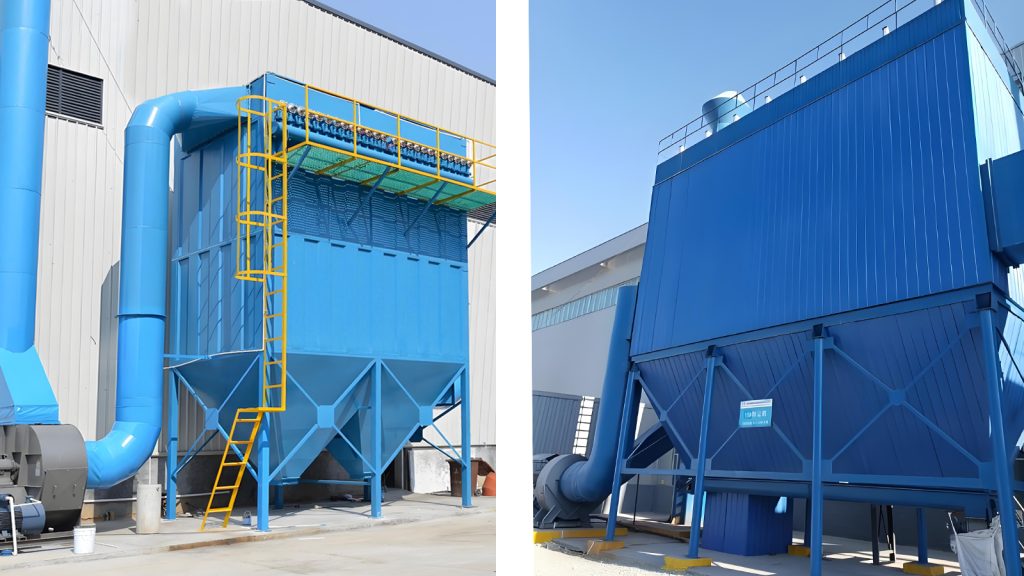
Determining the Processing Air Volume
The 5000 air volume means the filter processes 5000 cubic meters of gas per hour. In actual selection, you must determine the required air volume based on the production process and dust characteristics. If the air volume is too large, equipment size and energy consumption increase. If the air volume is too small, it may not meet dust removal needs. Therefore, it is advisable to reserve a 10%-20% margin during selection. This margin accommodates production fluctuations or future capacity increases.
Selecting the Filtration Velocity
Filtration face velocity refers to the speed at which gas passes through the filter media, measured in meters per minute (m/min). This parameter is critical as it directly impacts the dust collector’s efficiency and operational expenses. For a dust collector system rated at 5000 air volume, the typical filtration velocity ranges from 0.8 to 1.2 m/min. For high-density or adhesive dust, a lower face velocity (0.6-0.8 m/min) is advisable to minimize bag blinding and abrasion. For low-density dust, a slightly higher velocity (1.0-1.2 m/min) can be used to reduce the footprint and initial investment of the dust collection unit.
Choosing the Filter Bag Material
フィルターバッグ are the core component of a バッグハウス集塵機. Their material directly affects dust removal efficiency and service life. Common filter bag materials include polyester, polypropylene, PPS, and PTFE.
Polyester (Polyester Fiber): It is suitable for working temperatures below 120°C. It offers good acid and alkali resistance and lower cost. It is the first choice for most normal-temperature dust.
PPS (Polyphenylene Sulfide): It withstands high temperatures (up to 190°C). It has excellent resistance to acid, alkali, and oxidation. It is suitable for high-temperature, highly corrosive environments like coal-fired boilers and waste incineration.
PTFE (Polytetrafluoroethylene): It has excellent high-temperature (260°C) and corrosion resistance. However, its cost is higher. It is usually used for special working conditions.
During selection, choose the appropriate filter bag material based on dust temperature, humidity, and chemical properties.
Determining the Cleaning Method
The cleaning method of a bag filter directly affects filter bag life and dust removal efficiency. Common cleaning methods include pulse jet cleaning, mechanical vibration, and reverse air flow.
Pulse Jet Cleaning: This is currently the most commonly used cleaning method. It uses compressed air for instant jet cleaning of the filter bags. It provides good cleaning results. It is suitable for high-concentration dust and continuous operation.
Mechanical Vibration Cleaning: Its structure is simple, but cleaning effectiveness is poorer. It is typically used for small filters or intermittent operation.
Reverse Air Flow Cleaning: It is suitable for large filters, but energy consumption is higher.
For a 5000 air volume bag filter, the pulse jet cleaning method is recommended. This ensures efficient and stable operation.
Equipment Resistance and Energy Consumption
Equipment resistance refers to the pressure loss when gas passes through the filter. It is usually controlled between 1200-1500 Pa. Excessively high resistance increases fan energy consumption. Excessively low resistance may affect dust removal effectiveness. During selection, calculate equipment resistance based on air volume and filtration velocity. Then, select a matching fan power.
Dust Characteristics and Emission Requirements
Dust factors like particle size distribution, concentration, stickiness, and humidity all affect filter selection. For example, for fine dust with a particle size below 10μm, choose filter bags with high filtration precision. For high-humidity dust, consider anti-condensation measures. Furthermore, determine the emission concentration requirement based on local environmental standards (e.g., below 10 mg/m³ or 30 mg/m³). Then, select the corresponding dust removal efficiency.