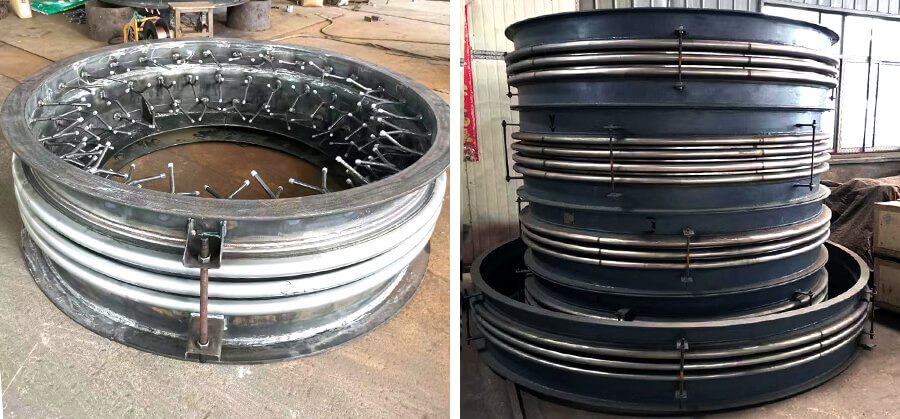
エキスパンション・ジョイントとは何ですか?
Also widely known as a bellows エキスパンションジョイント or pipe compensator, it is an essential flexible component designed for industrial pipeline systems and mechanical equipment. Engineered with durable metal bellows and matched sealing, connecting and protective accessories, an expansion joint absorbs thermal expansion and contraction, mechanical displacement, and operational vibration in pipelines. It eliminates excessive internal stress, prevents pipe cracking and leakage, and maintains the long-term stability and safety of diverse fluid transportation and engineering pipeline systems.
Many engineering practitioners and buyers search for “what is an expansion joint” to clarify its functions, applicable scenarios and selection standards for pipeline construction, operation and maintenance. Pipeline deformation, ground settlement and equipment vibration frequently cause hidden risks such as bracket damage and medium leakage. This article comprehensively answers core questions about expansion joints, covering their working principle, core functions, mainstream types, industry applications, selection guidelines and standardized maintenance tips, helping users fully understand and correctly apply pipe expansion joints.
Working Principle of Expansion Joints
The core functional component of an エキスパンションジョイント は metal bellows. The compensation performance, pressure resistance and service life of the entire expansion joint are determined by the material, structure and wall thickness of the bellows. Featuring outstanding elastic deformability, the bellows can achieve flexible displacement in axial, lateral and angular directions within a designed range.
When the pipeline system generates dimensional changes or displacement stress, the bellows absorbs excess stress and deformation through autonomous expansion, contraction and deflection. It converts the rigid acting force of hard pipelines into flexible deformation force, preventing stress accumulation on pipelines, fixed brackets and equipment interfaces, so as to protect the integrity and stability of the entire pipeline system.
Core Functions of Expansion Joints
Acting as a safety buffer for pipeline systems, expansion joints cover three core application scenarios: pipeline deformation compensation, vibration isolation and mechanical displacement protection. Their specific functions are detailed as follows:
Thermal Displacement Compensation (Core Function)
Pipelines transporting high-temperature or low-temperature media will undergo obvious thermal expansion and contraction due to temperature fluctuations. For rigid fixed pipeline systems without compensation devices, huge thermal stress generated by deformation will accumulate continuously on pipeline inner walls, fixed brackets and connected equipment. Minor issues include pipeline deformation, loose interfaces and medium leakage, while severe cases may cause pipeline bursting, bracket fracture and equipment damage, resulting in production shutdowns, leakage accidents and major safety risks. Expansion joints accurately absorb axial and radial thermal displacement of pipelines and release residual stress to ensure stable pipeline operation.
Vibration Isolation and Resonance Prevention
Industrial equipment such as water pumps, fans, compressors and generator sets produces continuous operating vibration. Rigidly connected pipelines will directly transmit vibration, causing high-frequency alternating stress inside pipelines. Long-term vibration leads to fatigue cracking at stress-concentrated positions including pipeline elbows, tees and welds, and easily triggers overall pipeline resonance, accelerating wear and tear of pipelines and equipment. With flexible buffering performance, expansion joints effectively block vibration transmission and reduce pipeline resonance, greatly extending the service life of pipelines and supporting equipment.
Mechanical Displacement and Ground Deformation Compensation
In complex engineering environments, foundation settlement, minor earthquakes, equipment offset and pipeline installation deviations will cause irregular mechanical displacement at pipeline and equipment interfaces. Rigid pipelines cannot adapt to such displacement changes, which easily leads to interface tearing and pipeline falling off. Expansion joints adapt to various minor mechanical displacements automatically, balance interface stress and prevent pipeline damage caused by abnormal displacement.
Noise and Vibration Reduction
In addition to core compensation functions, expansion joints effectively reduce noise and vibration caused by fluid impact and equipment operation. They lower operating noise in industrial plants and building HVAC systems, meet silent operation and maintenance requirements, and reduce fatigue loss of pipeline components.
Main Types and Characteristics of Expansion Joints
According to displacement compensation modes, structural design and applicable working conditions, industrial expansion joints are divided into four mainstream types. Each type has distinct application advantages and serves as the core basis for engineering selection:
Lateral Expansion Joint
構造: Consists of an intermediate connecting pipe, two sets of bellows, tie rods, end plates, spherical and conical gaskets, featuring high structural stability.
Core Features: Absorbs lateral displacement in any plane and restrains pressure thrust generated by pipeline media to avoid pipeline offset.
アプリケーション: Ideal for heating pipelines, HVAC water supply pipelines and factory conveying pipelines with large lateral displacement and long span, requiring axial offset limitation.
Pressure Balanced Expansion Joint
構造: Equipped with two working bellows at both ends and one balancing bellows in the middle, matched with tie rods and end plates to integrate compensation and pressure balancing functions.
Core Features: Specialized in axial displacement compensation, perfectly balances medium pressure thrust of bellows, reduces bearing pressure on fixed brackets and lowers overall engineering costs.
アプリケーション: Suitable for high-pressure, large-diameter and long-distance axial pipelines, widely used in petroleum, chemical, long-distance heating and gas transmission pipeline systems.
Angular Expansion Joint (Hinge Expansion Joint)
構造: Composed of a single bellows, pin shafts, hinge plates and limit structures, with a compact and positioning-accurate design.
Core Features: Absorbs angular displacement within a single plane, bears medium pressure thrust stably, and precisely controls pipeline deflection to prevent pipeline distortion.
アプリケーション: Applied to pipeline corners, elbow positions and arc layout pipelines, suitable for steam pipelines, chemical process pipelines and small-scale heating pipelines.
Force Balanced Expansion Joint
構造: Adopts a combined structure of double working bellows and intermediate balancing bellows, matched with high-strength tie rods and end plates for excellent pressure resistance.
Core Features: Focuses on axial displacement compensation, completely eliminates axial pipeline displacement caused by medium pressure thrust, and guarantees pipeline coaxiality and stability.
アプリケーション: Used for precision chemical pipelines, power station pipelines and high-pressure fluid transmission systems with strict requirements on pipeline stability and coaxiality.
Comprehensive Application Scenarios of Expansion Joints
Expansion joints are compatible with most fluid transmission and industrial pipeline systems, covering civil, industrial and municipal engineering fields. The core application scenarios are as follows:
HVAC and Building Water Supply & Drainage Systems
Central air conditioning water systems, heating pipelines and water supply & drainage pipelines in commercial buildings, residential complexes and office buildings face frequent thermal expansion and contraction due to seasonal temperature changes. Installing expansion joints compensates for temperature deformation, isolates vibration from water pump operation, prevents leakage at pipeline connections on ceilings and walls, and reduces building operation failures.
Power and Heating Engineering
Thermal power plants, centralized heating pipe networks and steam transmission pipelines feature high medium temperature, long pipeline span and large thermal displacement, making them core application scenarios for expansion joints. Pressure balanced and axial expansion joints efficiently absorb thermal deformation of high-temperature pipelines, protect pipe network brackets and valve equipment, and ensure year-round stable operation of heating systems.
Petroleum and Chemical Industry
Chemical pipelines transmit high-temperature, high-pressure, corrosive media such as acid and alkali, with complex working conditions including equipment vibration, foundation settlement and process displacement. Corrosion-resistant expansion joints adapt to special chemical media, compensate for multiple types of displacement, avoid leakage of corrosive media, and improve the safety of chemical production lines.
Municipal Gas and Water Supply & Drainage Engineering
Urban underground pipe networks are affected by foundation settlement, road rolling and seasonal temperature changes, resulting in frequent displacement and deformation. Expansion joints adapt to irregular displacement of underground pipelines, prevent cracking and leakage of gas and water transmission pipelines, and ensure long-term stable operation of municipal pipe networks.
Metallurgy, Mining and Heavy Industry
Metallurgical cooling water pipelines, mine transmission pipelines and heavy industry supporting pipelines suffer from severe equipment vibration and pipeline wear. Expansion joints isolate equipment vibration, buffer pipeline stress, reduce fatigue damage of heavy-duty pipelines, and cut down equipment shutdown and maintenance frequency.
Ship and Rail Transit Supporting Pipelines
Ship cabin pipelines and rail transit ventilation and fluid pipelines operate in long-term vibration, bump and micro-deformation environments. Specialized expansion joints adapt to dynamic displacement and vibration conditions, ensuring pipeline safety in special industrial scenarios.
Key Expansion Joint Selection Tips (Avoid Common Mistakes)
Reasonable model selection is critical to maximizing the service life and operational safety of expansion joints. Five core parameters must be considered in engineering selection:
- Medium Working Condition: Select materials according to transmission media (water, steam, gas, acid and alkali corrosive media). Carbon steel and ordinary stainless steel are suitable for conventional working conditions, while 304, 316L stainless steel or PTFE-lined expansion joints are preferred for corrosive environments.
- Temperature and Pressure Grade: Match the temperature and pressure resistance level of expansion joints based on the maximum operating temperature and rated pressure of pipelines. Thickened bellows and pressure balanced models are prioritized for high-temperature and high-pressure working conditions.
- Displacement Requirements: Select corresponding expansion joint types according to actual pipeline deformation types (axial, lateral, angular, composite displacement), and accurately calculate compensation capacity to avoid insufficient compensation or excessive redundancy.
- Installation Environment: Choose expansion joints with protective coatings and waterproof sealing structures for outdoor, underground, humid and corrosive environments to enhance weather resistance and durability.
- Pipeline Specifications: Strictly match pipeline diameter and connection methods (flange connection, welding, thread connection) to ensure installation adaptability and sealing performance.
Expansion Joint Installation and Daily Maintenance Specifications
Installation Precautions
- Inspect the appearance, bellows integrity and sealing accessories of expansion joints before installation, ensuring no deformation, damage or cracks.
- Do not forcibly stretch, twist or compress expansion joints, and avoid using expansion joints to correct pipeline installation deviations to prevent premature performance loss.
- Install tie rods and limit structures in accordance with working condition standards; retain pressure balancing structures for high-pressure working conditions to prevent pipeline thrust displacement.
- Remove factory fixed limit devices after installation to ensure free deformation of bellows and normal compensation function.
Daily Maintenance Guidelines
- Regularly inspect the bellows surface to avoid collision, wear and corrosion, and clean sharp hard objects around pipelines in a timely manner.
- Check for leakage at flange and sealing positions, and fasten loose tie rods and fasteners regularly.
- Conduct special quarterly inspections for high-temperature, high-pressure and corrosive working conditions, record deformation and wear status, and replace aging expansion joints in time.
- Take anti-freezing protection measures in low-temperature winter environments to prevent bellows cracking and material embrittlement failure.
Common Faults and Solutions of Expansion Joints
- Medium Leakage: Mainly caused by aging seals, misaligned flange installation or slightly damaged bellows. Replace sealing gaskets, recalibrate installation positions, and replace severely damaged expansion joints.
- Failed Compensation: Caused by unremoved limit devices, stuck bellows or over-tight tie rods. Remove limit structures, adjust tie rod tightness and fix deformation jamming problems.
- Aggravated Pipeline Vibration: Resulting from mismatched model selection or insufficient compensation capacity. Recalculate working condition parameters and replace with suitable expansion joints.
- Bellows Corrosion and Damage: Caused by material incompatibility with transmission media. Replace with corrosion-resistant professional expansion joints and strengthen pipeline anti-corrosion protection.
結論
As a core compensation accessory for industrial pipeline systems, expansion joints solve key pipeline system pain points including deformation stress, vibration and leakage through thermal displacement compensation, vibration isolation and mechanical displacement adaptation. They are widely applied in HVAC, power, chemical, municipal and heavy industry fields.
In engineering applications, accurate model selection, standardized installation and regular maintenance based on actual working conditions (temperature, pressure, medium, displacement) can maximize the application value of expansion joints, extend the service life of pipeline systems and reduce long-term operation and maintenance costs. Customized expansion joint solutions are available for pipelines with special working conditions and parameter requirements.