
Fine dust — the fraction that stays airborne, travels across a workshop and settles on precision components — is the hardest part of an industrial dust problem. A cartridge dust collector is often the right answer: pleated media gives a large filter area in a compact housing, and pulse-jet cleaning keeps resistance stable. But it is not a universal answer. Which media you choose, and where you draw the operating limits, decides whether the unit performs for years or blinds within a season.
This guide focuses on the decisions that actually change the specification: filter media grade, the dust conditions a cartridge collector should not be asked to handle alone, the sizing parameters, and the routine checks that protect the filter.
1. Why Fine Dust Needs a Different Approach
Fine particles behave differently from coarse grit. They remain suspended, follow room air currents rather than falling into a hopper, and can pass through media that handles larger particles comfortably. In a workshop this shows up as four separate problems: stack emissions approaching the permit limit, a visible haze on the shop floor, deposits on machine ways and electronics, and operator exposure. A collector specified on airflow alone rarely solves all four.
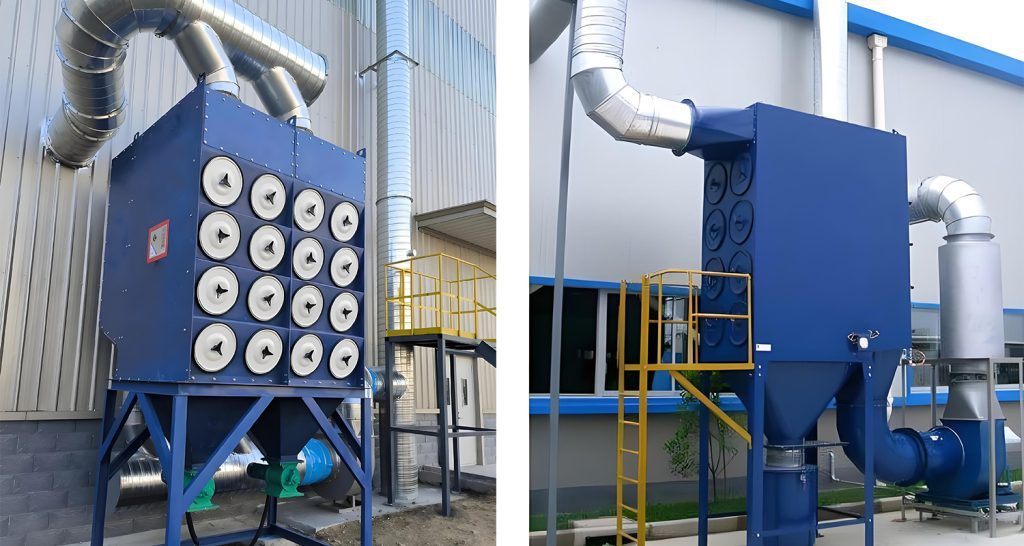
Cartridge collectors address this with a pleated filter element. Folding the media increases filter area several times over a flat bag of the same envelope, so a given airflow can be handled in a much smaller housing. Most industrial units clean the cartridges with short pulse-jet bursts of compressed air, which releases the dust cake without stopping the fan.
| Характеристика | What it means in practice | What to confirm before ordering |
|---|---|---|
| High surface area in a small envelope | Collector can sit close to the emission point, shortening duct runs | Actual filter area (m²), not just the number of cartridges |
| Fine-particle capture | Suitable for sub-5 μm fractions when the correct media grade is fitted | Efficiency claim, test method and media grade — see Section 4 |
| Импульсно-струйная очистка | Stable differential pressure under continuous duty | Pulse pressure, tank volume, valve type and cleaning cycle logic |
| Компактная площадь | Fits inside a workshop or on a mezzanine | Overall dimensions, access clearance for cartridge change-out |
| Lower installed air volume | Smaller fan than an oversized central system | Capture airflow at each hood, not a generic m³/h figure |
For a general introduction to how cartridge collectors work, see Cartridge Dust Collectors in Industrial Settings. This article deliberately goes further into media selection and limits.
2. Where Cartridge Collectors Reach Their Limit
This is the section most product pages skip, and the one that prevents most premature failures. Pleated media has narrow pleat spacing. Anything that makes dust stick, cake or arrive as coarse abrasive grit works against it.
| Dust or process condition | Risk to the cartridge | Recommended response |
|---|---|---|
| High humidity, condensation or wet dust | Dust cakes between pleats, differential pressure climbs, cleaning cannot release it | Enclosed dry handling, insulated or heated ducting, dew-point control; consider a wet scrubber or baghouse instead |
| Sticky, oily or hygroscopic powder | Progressive blinding that pulse-jet cleaning cannot reverse | Pre-coat or a different collector type; confirm with a dust sample trial |
| Coarse or abrasive particles, sparks | Pleat erosion and damaged media at the inlet face | Baffle, cyclone or dropout box ahead of the collector |
| Temperature above the media and end-cap rating | Media shrinkage, adhesive failure, gasket hardening | Select media for the actual temperature (Section 4) and add cooling or a spark trap |
| Combustible dust (aluminium, magnesium, wood, flour, many APIs) | Explosion risk inside an enclosed collector volume | Dust hazard analysis, explosion venting or flameless venting, isolation, bonding and correctly rated Ex equipment |
| High inlet concentration without pre-separation | Rapid dust cake build-up, short cleaning cycles, high compressed-air use | Pre-separator and staged cleaning |
Two common specification mistakes follow from this. First, a “99%+” efficiency figure is sometimes quoted without the media grade, dust cake condition or test standard behind it — ask for the test basis before comparing offers. Second, a cartridge collector is often described as automatically lower in resistance and energy use than a baghouse. Pleated media can in fact run at higher differential pressure; the defensible advantage is compactness at a given airflow, with energy performance depending on the fan, duct design and cleaning settings. For a structured comparison, see Which Is Better: Baghouse or Cartridge Dust Collector?.
3. Filter Media Selection: The Decision That Drives Everything Else
“Polyester cartridge” is not a specification. Media grade, treatment, end-cap adhesive and gasket material each set a different limit. Use this table as the basis of your enquiry.
| Media / treatment | Typical duty | Limit to verify | Common mistake |
|---|---|---|---|
| Standard spunbond polyester | Dry, non-abrasive fine dust at ambient temperature | Continuous temperature rating of the complete cartridge, including end caps, adhesive and gaskets — often lower than the media fibre itself | Quoting the fibre’s temperature instead of the assembled cartridge’s |
| Antistatic / conductive media | Flammable or combustible powders where static accumulation is a concern | Surface resistance, grounding continuity of cartridge, housing and ducting | Treating an antistatic cartridge as a complete explosion-protection concept |
| Flame-retardant media | Grinding, welding fume, wood dust with spark or ember carry-over | Flame-retardance rating, plus a spark trap or dropout section upstream | Assuming flame-retardant media replaces spark protection |
| High-temperature media (e.g. aramid, PPS, PTFE laminate, glass fibre) | Hot process air, dryer exhaust | Actual continuous and peak temperature, moisture and chemical content of the gas | Calling it a “high-temperature version” of a polyester cartridge — it is a different media |
| Chemical-resistant / PTFE membrane media | Pigments, catalysts, acidic or alkaline aerosols, sticky fine powders | Chemical compatibility with the specific compound, and cake-release behaviour | Choosing by chemical name only, without concentration and temperature |
| Food / pharmaceutical grade media | Powders where product-contact hygiene is specified | Media shedding behaviour, cleanability, material declarations and surface finish of product-contact parts | Assuming collected dust can be returned to a product batch (see Section 5) |
Temperature deserves one extra note. A figure such as 80 °C for a standard polyester cartridge usually reflects the assembled element — polyurethane end caps, adhesives and seals — rather than the polyester fibre, which tolerates more. Ratings in the 120–180 °C band generally require a different media family together with compatible end caps and gaskets. Always ask for the continuous and peak limits of the complete cartridge, not a single number from a media datasheet. For a wider material comparison, see How to Choose High Temperature Filter Bags and Cartridges и Filter Bag Materials Compared.
Not sure which media fits your dust? Send a dust sample description, particle size, moisture and temperature to DARKO through the cartridge dust collector inquiry form and we will recommend a media grade and configuration.
4. Sizing Parameters and Pre-Treatment
Once the media is settled, four numbers determine the build.
- Airflow (m³/h). Size from the sum of capture airflows at the hoods, then allow a margin — commonly around 10% — for duct leakage and rising filter resistance. Do not start from a nominal “model airflow”.
- Air-to-cloth ratio (m/min, also written m³/m²·min). Values around 0.8–1.2 m/min are common for cartridge collectors, but fine, light or high-concentration dust calls for the lower end of the range. Confirm which filter area the supplier used in the calculation; pleat geometry means the effective area is not always the flat media area. See Bag Filter Air-to-Cloth Ratio Control.
- Cleaning settings. Pulse pressure, pulse duration and interval should be tuned to dust concentration. Over-cleaning wastes compressed air and can drive dust into the media; under-cleaning lets resistance climb. See The Importance and Optimization of Pulse Jet Pressure.
- Pre-treatment. A baffle, dropout box or cyclone ahead of the collector removes coarse and abrasive particles and intercepts sparks, protecting the pleats. In humid plants, insulation or trace heating prevents condensation. For duct and hood design, see Optimizing Bag Filter Systems: Key Dust Hood Design Elements.
5. Application Map: Seven Fine-Dust Scenarios
The table below compresses the industry scenarios into the fields that change the specification. It is a starting point for discussion, not a substitute for a dust test.
| Приложение | Typical dust | Media / configuration focus | Constraint to flag |
|---|---|---|---|
| CNC machining, grinding, polishing, laser cutting | Fine metal swarf, aluminium, stainless, alloy powder | Antistatic media; spark trap for grinding | Combustible metal dust → full explosion-protection concept, not antistatic media alone |
| Electronics and PCB manufacturing | Resin, plastic, ceramic fines, soldering fume | High-efficiency media, low-shedding construction | Cleanroom compatibility, no re-entrainment into the room |
| Pharmaceutical and food powder handling | API, excipient, flour, starch, seasoning fines | Food/pharma grade media, cleanable product-contact surfaces, contained discharge | Collected dust is normally waste or held for QC release — it is not automatically returned to a product batch. |
| Fine chemicals: pigments, dyes, carbon black, catalysts | Corrosive or irritant ultrafine powders | PTFE membrane or chemical-resistant media, sealed discharge | Chemical compatibility at actual concentration and temperature |
| Wood and furniture sanding | Fine, lightweight wood flour | Flame-retardant media, spark detection | Combustible dust; dust-layer housekeeping and fire protection |
| Powder coatings, fillers, mineral fines | Talc, CaCO₃, quartz fines, coating powder | Compact unit integrated into the line, enclosed recovery | Recovery must be assessed for contamination before reuse |
| Welding and plasma cutting | Sub-micron welding fume aerosol | High-efficiency media with source capture arms or hoods | Occupational exposure limits at the operator position; verify with measurements, not a catalogue claim |
Each of these scenarios leads to a different media grade, discharge arrangement and protection concept. Available builds are summarised on the DARKO cartridge dust collector product page.
For heavy-industry applications, Использование картриджных коллекторов в сталелитейной промышленности covers moisture and sticky-particulate control in more detail.
6. Routine Checks That Protect the Filter
A maintenance schedule for a cartridge collector is mostly about differential pressure and seal integrity. Keep it short and measurable.
| Частота | Check | Action trigger |
|---|---|---|
| Ежедневно | Differential pressure trend across the filter | Sustained rise → inspect pulse system, compressed-air supply and hopper discharge |
| Еженедельно | Pulse valve operation, tank pressure, condensate drain | Weak or missing pulse → clean or replace diaphragm and solenoid |
| Еженедельно | Hopper level and discharge device | Accumulation → clear and check the rotary valve or slide gate |
| Ежемесячно | Cartridge condition through the inspection door | Damage, deformation, pleat collapse or media shedding → replace the affected element |
| Ежемесячно | Duct, inspection door and gasket tightness | Air ingress → reseal; leakage reduces capture at the hood |
| Ежеквартально | Dust build-up in ducting and around pleat roots | Build-up → adjust cleaning interval and review pre-separation |
| On change of duty | Temperature, moisture and dust type against the media rating | Any excursion outside the rating → re-select media before continuing operation |
Never introduce dust that is above the cartridge’s temperature rating, condensing, or strongly adhesive: the resulting blinding is often irreversible. For a broader maintenance framework, see Техническое обслуживание рукавного пылесборника: руководство по ежедневному осмотру и устранению неисправностей и 7 Essential Wear Parts. Humidity-related failures are covered in High Humidity Dust Problems in Baghouse.
7. Frequently Asked Questions
Can a cartridge collector handle dust below 5 µm?
Yes, with the correct media grade and a stabilised dust cake. Efficiency figures such as “99%+” are only meaningful alongside the media grade, the particle size tested and the test standard, so request the test basis rather than comparing headline numbers.
When should I choose a baghouse instead?
High humidity or condensation, sticky or oily dust, coarse abrasive particles, high temperature beyond the cartridge assembly rating, and heavy spark load generally favour a baghouse, cyclone pre-separation or a wet system. See Which Is Better: Baghouse or Cartridge Dust Collector?.
Is an antistatic cartridge enough for aluminium or magnesium dust?
No. Antistatic media is one control within a broader explosion-protection concept that includes a dust hazard analysis, venting or flameless venting, isolation, equipotential bonding and dust-rated Ex equipment. Combustible metal dust is Group IIIC, not a gas group.
What air-to-cloth ratio should I specify?
Values around 0.8–1.2 m/min are common, with lower values for fine, light or high-concentration dust. Confirm the filter-area basis used in the calculation, since effective pleated area differs from flat media area.
Can recovered powder be returned to production?
Only where a documented quality-release and cross-contamination assessment permits it — in food and pharmaceutical production it is usually treated as waste. Specify containment, cleanability and discharge arrangements at the enquiry stage rather than assuming recovery is available.
8. Specify the Media, Then the Machine
A cartridge dust collector earns its compactness when the pleated media is matched to the dust: dry and free-flowing, within the assembled element’s temperature rating, protected from coarse grit and sparks, and — for combustible powders — backed by a complete explosion-protection concept. Get those four decisions right, keep the differential pressure trend under review, and the unit will stay stable for years.
DARKO supplies cartridge dust collectors for machining, electronics, food and pharmaceutical powder handling, fine chemicals, woodworking, mineral fines and welding fume. Send your dust data, airflow and installation constraints through the cartridge dust collector product page and we will return a media recommendation, a configuration sheet and a quotation.
 English
 Russian
 French
 Portuguese
 Arabic
 Spanish
 Japanese