
In the field of industrial environmental protection, baghouse dust collectors and cartridge dust collectors are the two most widely used types of equipment for industrial dust removal. Both operate on the core principle of filtration, but due to differences in filter media structure, cleaning methods, and equipment design, they are suitable for significantly different operating conditions. As two mainstream types of dry dust collection equipment, they are widely used in industries such as cement, metallurgy, mining, building materials, chemicals, and food processing, each offering unique advantages and suitable applications. Many industrial enterprises often face difficulties when choosing between the two—this article will comprehensively analyze their definitions, functions, drawbacks, and core differences to help you make the most suitable choice.
What is a Baghouse Dust Collector?
A baghouse dust collector is a dry-type dust filtration system. It is suitable for capturing fine, dry, non-fibrous dust. It consists of a hopper, a filtration chamber, a clean air chamber, a pulse-jet cleaning system, and a control system. The operating principle involves passing dust-laden gas through filter bags, where dust particles are trapped on the surface of the bags, while clean gas passes through the bags and is discharged, thereby achieving dust removal.
What is a Cartridge Dust Collector?
Cartridge dust collectors are highly efficient dry-type dust collection systems that use pleated filter cartridges as their core filtration elements. These systems utilize advanced filtration materials such as polyester fibers and nanofibers, with the filter media folded into pleats. They feature a large filtration area, high dust removal efficiency (up to 99.99%), low pressure drop, a compact design, and a small footprint.
Baghouse vs Cartridge Dust Collector: Which is Better?
There is no absolute “better” option, only a more suitable one based on actual working conditions. The best choice depends on dust characteristics, operating temperature, processing airflow, installation space, maintenance capacity, and budget. Below is a comprehensive comparison covering structural differences, dust adaptability, airflow performance, installation environment, and maintenance costs.
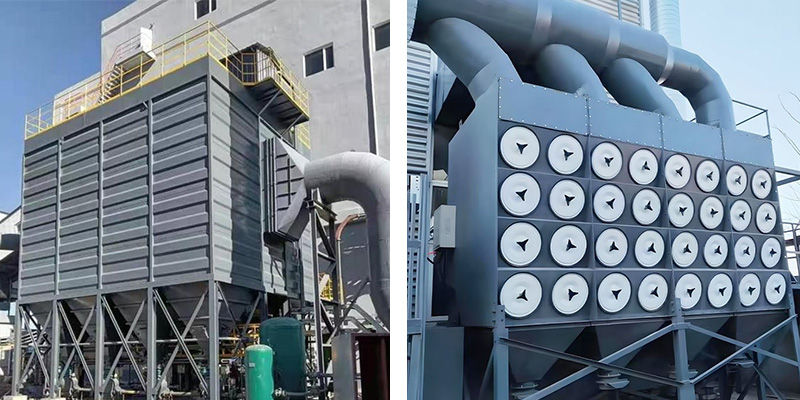
Key Structural Differences Between Baghouse Dust Collectors and Cartridge Dust Collectors
The differences in operational suitability between baghouse dust collectors and cartridge dust collectors stem fundamentally from their core structural differences—specifically, variations in filter media configuration and cleaning methods—which directly determine their ability to adapt to operational parameters such as dust concentration, temperature, and airflow. Only by first clarifying these core structural differences can one better understand the logic behind operational suitability and avoid making uninformed selection decisions.
(1) Core Structure of Baghouse Dust Collectors
The filter bag serves as the core filtration element. These cylindrical bags are suspended vertically inside the dust collector housing and supported by filter cages to prevent collapse. Dust cleaning primarily relies on pulse-jet or reverse-air cleaning; some large-scale equipment uses air-chamber pulse cleaning. Compressed air is injected to dislodge dust from the filter bag surface, thereby regenerating the filter bag. Its core advantages include a large filtration area and high dust-holding capacity, making it suitable for high-concentration dust applications.
(2) Core Structure of Cartridge Dust Collectors
The filter cartridge serves as the core filtration element. It features a pleated structure and is installed horizontally or vertically, providing a concentrated filtration area (the pleated design significantly increases the filtration area per unit volume). The cleaning method is typically pulse-jet cleaning, where the jet of compressed air acts directly on the surface of the filter cartridge, resulting in high cleaning efficiency and low energy consumption. Its core advantages include a compact equipment footprint and high filtration precision, making it suitable for applications with limited space and strict dust emission requirements.
Comparison in application scenarios
1. Adaptability to dust characteristics
Dust concentration, particle size, stickiness, and temperature are the most critical factors in dust collector selection.
Dust concentration
- Baghouse dust collector: Suitable for high-concentration dust conditions, with inlet dust concentration ranging from 1000–10000 mg/m³ or higher. High dust-holding capacity reduces frequent cleaning and avoids rapid clogging. Ideal for mining, crushing, metallurgy, cement plants, and coal-fired boilers.
- Cartridge dust collector: Better suited for low to medium dust concentration (100–1000 mg/m³). Limited dust-holding capacity may lead to fast clogging and increased cleaning frequency under heavy dust loads. Suitable for machining, welding, electronics, and food processing.
Particle size
- Baghouse dust collector: Works effectively for both coarse particles (>10μm) such as ore dust and cement dust, and fine particles (<1μm). Abrasion-resistant filter materials ensure long service life.
- Cartridge dust collector: Performs best with fine dust particles (<5μm) and meets strict emission standards. Coarse abrasive particles can quickly wear and damage pleated surfaces, so it is not recommended for heavy coarse dust applications.
Dust stickiness
- Baghouse dust collector: Handles moderately sticky dust well. With anti-stick filter media such as PTFE and optimized cleaning cycles, it can operate reliably even with mildly adhesive dust.
- Cartridge dust collector: Only suitable for low-stickiness dust. Sticky dust easily accumulates in pleated gaps and is difficult to remove, leading to persistent clogging and shortened service life.
Operating temperature
- Baghouse dust collector: Excellent high-temperature resistance. Standard polyester bags withstand up to 120°C; high-temperature materials such as FMS and PTFE can handle 200–260°C. Ideal for boiler flue gas, industrial kilns, and metallurgical waste gas.
- Cartridge dust collector: Limited temperature resistance. Standard cartridges withstand 80–100°C; high-temperature cartridges up to 120°C. Mainly designed for room-temperature applications.
2. Adaptability to airflow and system parameters
Processing airflow
- Baghouse dust collector: Designed for large airflow applications from 10,000 to 100,000 m³/h. Capacity can be expanded by increasing the number of filter bags.
- Cartridge dust collector: Suitable for small to medium airflow (1,000–10,000 m³/h). Large airflow requirements usually require multiple parallel units, increasing investment and footprint.
System pressure and resistance
- Baghouse dust collector: Stable running resistance at 1000–1500 Pa, suitable for general industrial dust extraction systems.
- Cartridge dust collector: Slightly higher resistance at 1500–2000 Pa, more suitable for systems prioritizing emission quality over low pressure drop.
Emission performance
- Baghouse dust collector: Typical emission level 5–10 mg/m³; high-efficiency filter bags can achieve below 1 mg/m³, meeting most industrial emission standards.
- Cartridge dust collector: Higher filtration precision, with typical emissions of 1–5 mg/m³, and ultra-fine cartridges reaching below 0.1 mg/m³, ideal for food, pharmaceutical, and electronic industries.
3. Installation space and environmental adaptability
Installation space
- Baghouse dust collector: Larger overall size, requiring more floor space and vertical height. Suitable for spacious factories and new production lines.
- Cartridge dust collector: Compact structure, occupying only 1/3 to 1/2 the space of a baghouse dust collector. Ideal for narrow workshops, retrofitting projects, and small processing stations.
Humidity environment
- Baghouse dust collector: Tolerates relative humidity up to 85%. With insulation or heating devices, it can avoid condensation and clogging in high-humidity environments.
- Cartridge dust collector: Sensitive to high humidity, best for environments below 70% RH to prevent dust adhesion, clogging, and mold growth.
4. Maintenance and operating cost comparison
Maintenance difficulty
- Baghouse dust collector: Moderate maintenance difficulty. Filter bags can be replaced individually, but large quantity may increase labor time.
- Cartridge dust collector: Easier and faster maintenance with fewer cartridges. However, unsuitable working conditions may lead to frequent replacement.
Service life and long-term cost
- Baghouse dust collector: Higher initial investment, but longer filter life (1–3 years) and lower overall long-term operating cost.
- Cartridge dust collector: Lower upfront cost and easier installation, but shorter filter life (6–12 months). Long-term expenses may be higher under harsh conditions.
Recommended industries for baghouse and cartridge dust collectors
Best applications for baghouse dust collectors
- Mining: crushing, screening, conveying
- Metallurgy: smelting, high-temperature flue gas treatment
- Building materials: cement plants, stone processing, ceramic production
- Coal-fired boilers and industrial kilns
- Chemical industry with medium-concentration and medium-sticky dust
Best applications for cartridge dust collectors
- Machining: grinding, cutting, welding fume extraction
- Electronics manufacturing and PCB production
- Food processing: flour, grain, powder handling
- Pharmaceutical production and fine chemical processing
- Small workshops with limited installation space
Conclusion
When comparing baghouse dust collectors and cartridge dust collectors, there is no “better” choice—only the one that is better suited to specific operating conditions.
Baghouse dust collectors are better suited for heavy industrial applications with high dust concentrations, high temperatures, high airflow, and harsh environments, such as the cement, mining, metallurgy, and boiler industries.
Cartridge dust collectors, on the other hand, perform better in scenarios with limited space, fine dust particles, low to medium dust concentrations, and strict emission requirements, such as in the machining, food, electronics, and pharmaceutical industries.
If you need assistance selecting the right dust collector, customizing an industrial dust collection system, or obtaining a tailored solution for your facility, please feel free to contact our professional team for technical support at any time.
 English
  Russian
  French
  Portuguese
  Arabic
  Spanish
  Japanese