
What Is Coal Gangue?
Coal gangue, also referred to as coal refuse or gob, is a hard, rock-like solid by-product produced during underground coal mining and coal washing processes. It forms alongside coal seams and contains a mix of shale, sandstone, clay minerals and residual fine coal. Coal gangue normally accounts for roughly 10% to 25% of total coal output. For decades, most gangue was simply stockpiled on mine sites as waste. Unmanaged stockpiles take up valuable land, risk spontaneous combustion, cause acid leaching and create widespread fugitive dust issues. Today, many mines process coal gangue through crushing and screening to turn this waste material into saleable construction aggregates, brick raw materials or lightweight aggregate. However, the crushing circuit brings a well-known safety headache: combustible gangue dust.
Why Is Coal Gangue Crushing Dust So Hazardous?
Once crushed, the residual fine coal inside gangue turns into airborne combustible dust. When suspended dust reaches the right concentration inside enclosed equipment, even a small ignition source such as a spark from crusher impact, hot slag or static discharge can trigger a dust deflagration. Gangue dust is also highly abrasive. Sharp mineral particles wear ductwork, filter media and processing equipment rapidly. That is why standard dust collectors cannot handle this application. Plants need a purpose-built explosion-proof pulse jet baghouse designed for combustible, high-abrasion mineral dust.
Coal gangue is a common by-product generated during coal mining and coal washing operations. When gangue goes through crushing and screening circuits, it releases challenging particulate: the dust is combustible, high in concentration, covers a wide particle size range, and causes heavy abrasive wear on processing equipment. Without reliable dust extraction, plants face severe combustible dust explosion risks, accelerated equipment degradation, poor site air quality, and lost opportunities for gangue resource valorization.
Um explosion-proof pulse jet baghouse has become the preferred dust collection solution for coal gangue crushing lines. This article breaks down its optimized design, working mechanism, on-site performance gains and technical innovations built specifically for gangue processing conditions.
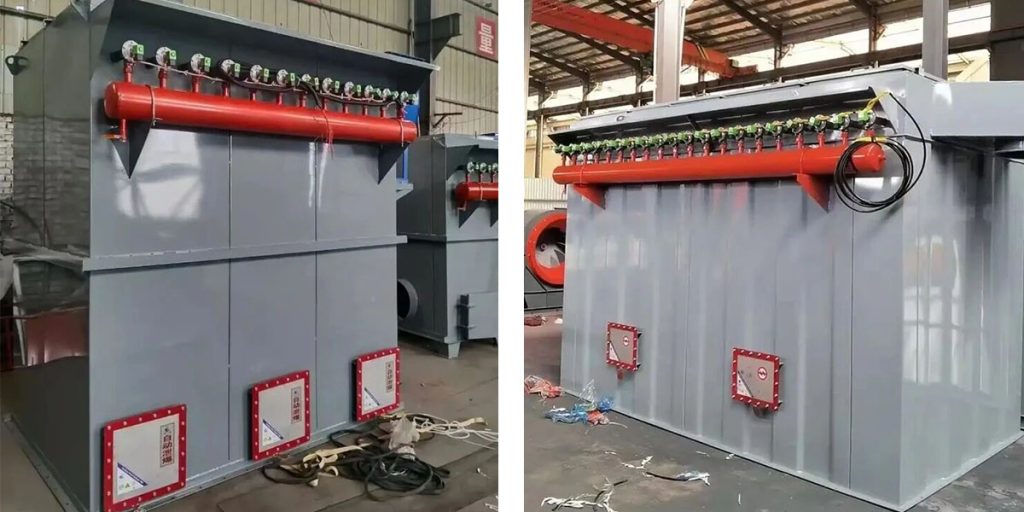
Modular Design: Integrated Explosion Protection and Targeted Dust Capture
This pulse jet baghouse is engineered for the unique hazards of gangue crushing dust. It uses modular assembly and combines sealed capture hoods, anti-static filter bags, automatic pulse cleaning, and PLC intelligent controls. The whole system forms a three-layer protection strategy: source containment, in-line particulate interception and multi-level explosion safety.
Sealed Dust Capture Hoods for Crusher and Screening Points
Custom sealed hoods wrap crusher feed openings, discharge chutes and screening decks. Optimized negative-pressure airflow guides fugitive dust into the baghouse and cuts down unmanaged dust escape. The interior surface of each hood is coated with an abrasion-resistant layer, extending service life under continuous impact from sharp gangue particles.
Anti-Static Filter Bag Array with Membrane Surface Treatment
Filter bags are manufactured from conductive anti-static media with surface membrane finishing. This material balances heat resistance, chemical stability and static dissipation — a must-have feature for any ATEX-compliant baghouse handling combustible coal dust. Bags are arranged in dense, closely spaced rows to maximize total filtration area while keeping airflow resistance low. The membrane captures ultra-fine particulates reliably and stabilizes filtration performance.
Intelligent Pulse Jet Cleaning System with Differential Pressure Feedback
The pulse cleaning unit includes low-pressure pulse valves and reinforced blowpipes, managed by a PLC controller. The system reads real-time differential pressure from transmitters installed inside the baghouse and adjusts pulse frequency and air pressure dynamically. Cleaning only activates when pressure hits the preset threshold, preventing over-blowing that wears filter media prematurely.
Compressed air at 0.4–0.6 MPa releases in rapid bursts of just 0.1–0.2 seconds. Each pulse shakes off the dust cake without disrupting overall airflow, ideal for continuous crushing operations.
Multi-Stage Safety Hardware for Combustible Dust Risk Mitigation
Safety is non-negotiable for a baghouse for coal gangue crushing. This explosion-proof configuration includes pressure relief vents at the top chamber, spark detection and automatic extinguishing hardware, explosion-rated motors, and full bonding & grounding circuits. The combination aligns with NFPA 68 and NFPA 69 standards for combustible dust deflagration protection, building multiple safety barriers for upset operating conditions.
Working Principle: Air-Solid Separation and Recoverable Fines Collection
The pulse jet baghouse dust collector operates in three sequential phases under induced draft negative pressure: pre-separation, surface filtration and on-line pulse cleaning, balancing efficient dust capture and material recovery.
Stage 1: Negative Pressure Intake and Coarse Particle Pre-Separation
Dust-laden air is pulled into the baghouse by the induced draft fan. Larger particles above 50 μm drop directly into the hopper via gravity and inertial baffles. Pre-separation reduces the dust load hitting the filter bags and lowers abrasive wear on the filtration media.
Stage 2: Fine Particulate Interception by Anti-Static Filter Bags
Finer gangue and coal dust below 50 μm travel into the filter chamber and are trapped on the outer surface of anti-static membrane bags. A stable dust cake forms on the membrane, which delivers consistent capture efficiency for submicron dust particles. Well-tuned systems maintain filtration efficiency above 99.9% for fine coal gangue particulates.
Stage 3: Automatic Pulse Jet Dust Cake Removal
When differential pressure rises to the set trigger range of 1200–1500 Pa, the PLC triggers the pulse sequence. Short compressed-air pulses flex the filter bags rapidly; inertial force releases the dust cake, and collected fines fall down into the collection hopper ready for discharge or pneumatic conveying. Since cleaning runs online, the crushing circuit does not need frequent shutdowns.
Field Performance: Environmental Control and Operational ROI for Gangue Plants
Installing this explosion-proof pulse jet baghouse on a gangue crushing circuit delivers measurable operational, safety and financial returns.
Low Particulate Emissions for Mineral Processing Sites
Properly commissioned systems maintain outlet dust concentrations below 10 mg/m³, helping operators meet strict regional air emission requirements. Fugitive dust at crushing and screening stations drops sharply, lowering workers’ exposure to respirable mineral dust and improving overall site housekeeping.
Recover Coal Fines for Secondary Raw Material Reuse
One major advantage of this dust collection system for coal gangue crusher is resource recovery. Fine coal particles under 75 μm captured in the hopper can be sent via pneumatic conveying to downstream mixing processes. These recovered coal fines work as a partial replacement for clay feedstock, improving plasticity of raw mixes and cutting thermal energy consumption during sintering.
Long Filter Life and Reduced Plant Downtime
The anti-static membrane filter bags can run reliably for over 3 years with optimized pulse cleaning logic. Plant data shows overall equipment failure rates drop by roughly 60%, annual continuous runtime reaches 8000 hours, and routine maintenance expenses fall by 40%.
Technical Innovation Roadmap for Next-Generation Dust Collection
What sets this solution apart from conventional casas de sacos is the integrated safety + adaptive cleaning design built exclusively for abrasive, combustible gangue dust. Traditional dust collectors often run fixed pulse cycles, wasting compressed air and wearing bags fast, while separate explosion protection devices lack interlock coordination. This design links spark detection, venting protection and differential-pressure pulse cleaning into one unified control logic.
Looking ahead, IoT sensors and cloud-based analytics will upgrade these baghouse systems further. Predictive maintenance alerts, real-time energy tuning and emissions tracking will help mining and gangue-processing facilities optimize power use and support low-carbon operation.
FAQ: Common Questions About Explosion-Proof Baghouses for Gangue Crushing
What is coal gangue used for?
Processed coal gangue can be manufactured into construction aggregate, lightweight ceramsite, brick raw material, or used as filling material for mine backfill. Crushing is the first critical step to turn waste gangue into saleable products.
Is a standard pulse jet baghouse safe for coal gangue dust?
No. Ordinary bag filters lack anti-static media, spark suppression and explosion venting. Coal gangue contains combustible coal fines, so only ATEX / NFPA compliant explosion-proof baghouse systems are suitable for crushing and screening circuits.
What is the difference between online pulse cleaning and offline cleaning for gangue dust?
Online pulse jet cleaning cleans one row of bags at a time without stopping airflow, which fits continuous crushing lines. Offline cleaning isolates chambers and works better for extremely high dust loads but requires more complex chamber switching hardware.
Can captured gangue dust be reused instead of treated as waste?
Yes. Fine coal fractions recovered by the baghouse are valuable secondary feedstock for brick, lightweight aggregate and sintering production. This turns dust control from a pure compliance cost into a circular economy benefit for gangue processors.
Final Takeaway
For coal gangue crushing and screening operations, the explosion-proof pulse jet baghouse addresses the dual challenge of combustible dust safety and efficient particulate recovery. By combining abrasion-resistant capture design, anti-static membrane filtration, adaptive pulse cleaning and layered explosion protection, it supports safer, cleaner and more profitable mineral waste processing.
If you are sourcing a custom anti-static bag filter for gangue crushing plant or upgrading an existing dust extraction circuit, our engineering team can tailor a baghouse layout matched to your airflow, dust loading and zone classification requirements.Contacte-nos to get the latest quotation and customized technical solution.
 English
  Russian
  French
  Portuguese
  Arabic
  Spanish
  Japanese