
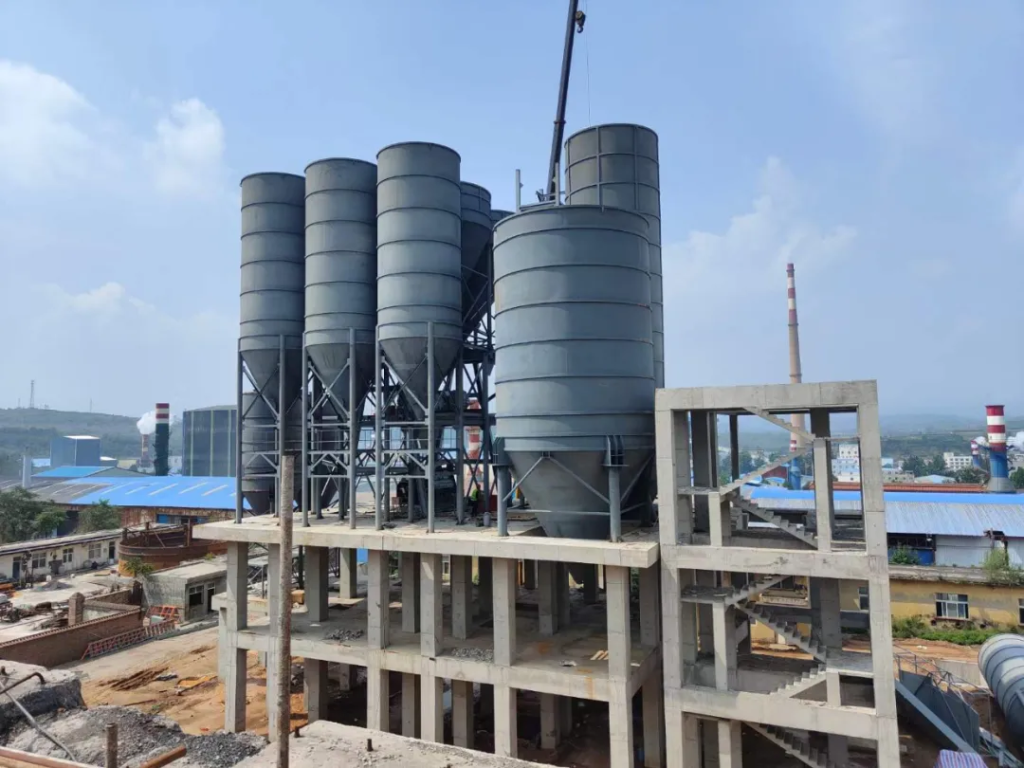
A cement silo that will not discharge reliably is one of the most common and most disruptive problems in a packing or batching plant. The silo is full, the material is there, but the outlet runs empty while the level indication barely moves. Operators strike the cone with hammers, open the inspection door, or run the feed line at reduced rate.
Three flow aids are normally proposed: air cannon, bin vibrator and fluidizing pad. Each works on a different principle, each suits a different failure mode, and each has a characteristic way of making the problem worse when applied to the wrong material.
This guide explains why cement silos stop discharging, how each device actually works, what it can and cannot fix, and how to select and install the right one.
1. Short Answer
Sintoma | Most likely cause | First choice |
Stable arch over the outlet, material will not fall | Cohesive arch in fine, dry powder | Air cannon, or fluidizing pad on the cone |
Vertical channel in the centre, side material static | Rat hole, funnel flow | Fluidizing pad, or cone and outlet redesign |
Material hangs on the cone wall in patches | Wall friction, moisture | Air cannon aimed at the hang-up zone |
Discharge rate falls gradually over weeks | Compaction, moisture ingress | Air cannon, plus drying of the air supply |
Hardened material, will not move under any air blast | Cement hydration, true set | Manual clearing with a safe procedure, or a lump breaker |
Flow stops only after long idle periods | Consolidation during storage | Fluidizing pad, or air cannon on a timed cycle |
The single most important distinction: a vibrator is the wrong tool for fine cement powder. Continuous vibration consolidates fine powder against the cone wall and reduces discharge rather than restoring it.
2. Why Cement Silos Stop Discharging
Discharge failure is a flow problem, not a storage problem. Five mechanisms account for most cases:
- Cohesive arch.A stable dome forms across the outlet because the powder has enough cohesion to span the opening. Common with dry, fine cement and fly ash, especially when the outlet is small.
- Rat hole.Material flows in a narrow channel above the outlet while the rest of the silo stays static. The silo appears to discharge, but the live capacity is a fraction of the stored volume.
- Wall hang-up.A layer of material sticks to the cone wall, usually where moisture condenses or where the cone angle is too shallow for the material’s internal friction.
- Fine powder consolidates under its own weight and vibration, increasing bulk density and inter-particle friction until flow stops.
- Hydration and set.Moisture entering through a manhole, a faulty gasket or damp conveying air causes partial cement hydration. The affected material is no longer a powder and cannot be moved by air or vibration.
The first four are flow-aid problems. The fifth is not, and treating it as one wastes time and equipment.
3. Air Cannon
3.1 How It Works
An air cannon stores compressed air in a pressure vessel and releases it through a quick-opening valve into a discharge nozzle aimed at the material. The release takes a fraction of a second, producing a pressure wave that breaks the arch or dislodges wall hang-up.
3.2 Where It Works
- Large-diameter silos where wall-mounted devices cannot reach the flow zone.
- Compacted or partially agglomerated material that needs a high-energy impulse.
- Hang-up on cone walls and at transitions, where the nozzle can be aimed directly.
- Periodic, timed operation on silos that stand idle for long periods.
3.3 Limits
- Ineffective on true set.Hardened cement will not break under an air blast.
- Air supply dependency.Requires a compressor, receiver, dryer and piping. Wet air defeats the device and worsens hydration.
- A cannon firing close to a working area is loud; silencers and timing are needed.
- Placement sensitivity.A cannon aimed at the wrong height does nothing for an arch at the outlet; multiple units at different elevations are often required.
- Not a metering device.It restores flow; it does not control rate.
3.4 Selection Points
Parâmetro | Typical guidance |
Tank volume | 1–10 L for small bins, 20–100 L for large silos |
Operating pressure | 0.4–0.7 MPa, from a dedicated receiver |
Nozzle size and type | Matched to tank volume; fan-jet nozzles cover a wider wall area |
Number of units | Two or more on large cones, at different elevations |
Firing interval | Timed cycle, typically several minutes apart, not continuous |
Air quality | Dried and filtered; condensate traps on the supply line |
4. Bin Vibrator
4.1 How It Works
A bin vibrator uses an eccentric motor or an electromagnetic driver to apply vibration to the silo wall or cone. The vibration is transmitted through the steel shell and is intended to overcome wall friction.
4.2 Where It Works
- Small steel bins and hoppers with short residence times.
- Free-flowing granular material with light wall adhesion.
- Situations where a compressed air supply is not available.
- Light bridging that has not yet consolidated.
4.3 Limits
- Fine powder compaction.This is the central problem. Cement and fly ash consolidate under sustained vibration; bulk density rises, friction increases and the discharge rate falls. Many plants install a vibrator and find the blockage worse within weeks.
- Structural effects.Continuous vibration causes fatigue cracking at welds, loosened bolts and cracked cone seams. The repair often costs more than the original problem.
- No reach.A vibrator acts on the wall it is mounted to. Material arching across the centre of a large silo is unaffected.
- Concrete silos.Vibration is largely ineffective on concrete or lined structures.
4.4 Correct Use
Use a vibrator only on small steel bins, only for intermittent duty, and only with material that is not a fine cohesive powder. Mount it on the cone slope, roughly one third of the way up from the outlet, and never directly at the outlet flange where it interferes with the discharge device. Operate in short cycles of a few seconds with a defined interval, not continuously.
5. Fluidizing Pad
5.1 How It Works
A fluidizing pad is a porous plate or fabric-covered panel set into the cone or the flat bottom of the silo. Low-pressure air passes through the porous medium and into the material, locally reducing inter-particle friction so the powder behaves like a liquid and flows toward the outlet.
5.2 Where It Works
- Fine, dry powders: cement, fly ash, limestone powder, raw meal.
- Shallow cones or flat-bottom silos where gravity alone cannot produce flow.
- Silos that need continuous, gentle flow restoration rather than an impulse.
- Situations where noise and mechanical vibration must be avoided.
5.3 Limits
- Air must be dry.Moist air blinds the porous medium and, worse, hydrates the cement around it. A refrigerated dryer is usually required.
- Blocked material.A pad cannot move agglomerated or set material.
- Only the area above the pad is fluidized, so pads must cover a meaningful proportion of the cone surface.
- Continuous air demand.Fluidizing consumes air for as long as it operates, unlike a cannon.
5.4 Selection Points
Pad area | 30–60% of the cone surface, arranged symmetrically |
Air pressure | Low pressure, roughly 0.02–0.05 MPa |
Air quality | Dried to a dew point below the silo wall temperature |
Fabric | Air-permeable, cement-resistant, replaceable |
Controlo | Zoned, so only the pads above the active flow area run |
Manutenção | Periodic inspection for blinded fabric and air distribution blockage |
6. Comparison
Fator | Air cannon | Bin vibrator | Fluidizing pad |
Energy type | Compressed air impulse | Mechanical vibration | Low-pressure air flow |
Best material | Compacted, agglomerated, coarse | Free-flowing granular | Fine dry powder |
Suits fine cement | Yes, with correct placement | No, causes compaction | Yes |
Suits large silo | Yes | No | Yes |
Effect on structure | Baixo | Fatigue risk on welds and bolts | Very low |
Air supply required | High pressure, dried | Nenhum | Low pressure, dried |
Ruído | High at firing | Moderate, continuous hum | Very low |
Operation pattern | Timed impulse | Short cycles | Continuous or zoned |
Fails on set material | Yes | Yes | Yes |
Typical maintenance | Valve, nozzle, receiver | Bearings, mounts, shell cracks | Fabric replacement, air quality |
7. When No Flow Aid Will Work
Three conditions defeat every air-based device. Recognising them early avoids buying equipment that cannot solve the problem.
Hardened material. If cement has hydrated inside the silo, it is a solid. No cannon, vibrator or pad will move it. The material must be removed by a controlled procedure with confined-space precautions, and the source of moisture — a leaking manhole gasket, wet conveying air, condensation on the cone — must be fixed before refilling.
Outlet too small or cone too shallow. A 150 mm outlet on a 60-degree cone may be adequate for free-flowing cement but marginal for fine, cohesive powder. No amount of air will create flow through an opening the material can arch across. In this case the fix is geometry: larger outlet, steeper cone, or a different insert.
Channelling from a static heel. If the silo has never been fully emptied, a compacted heel builds up and the live channel narrows over time. Flow aids then act on a progressively smaller volume. Cleaning out the silo and establishing a full-empty cycle is part of the solution, not an optional extra.
Where lumps form from agglomeration rather than set, a lump breaker at the outlet handles material that flow aids cannot. The selection points for that device are covered in our lump breaker buying guide.
8. Selection Checklist
Question | Air cannon | Vibrator | Fluidizing pad |
Is the material a fine cohesive powder? | Bom | Avoid | Best |
Is the material granular and free-flowing? | Acceptable | Acceptable | Pobres |
Is the silo large in diameter? | Bom | Pobres | Bom |
Is compressed air available and dry? | Required | Not needed | Required |
Is noise near workers a concern? | Needs silencer | Moderado | Best |
Is the structure concrete? | Bom | Ineffective | Bom |
Is the blockage hardened? | No | No | No |
9. Installation Rules
- Never mount a device at the outlet flange.It interferes with the discharge valve and creates a dead zone.
- Aim at the failure zone.For an arch, the nozzle must reach the arch plane; for wall hang-up, aim at the wall.
- Use more than one point on large silos.A single device on a 6 m diameter cone covers a small area.
- Interlock with discharge.Run the flow aid only while the discharge device is running; otherwise the aid compacts material against a closed outlet.
- Control the air quality.Dried air protects both the porous medium and the cement.
- Provide access for maintenance.Pads must be replaceable and nozzles removable without entering the silo.
10. Common Mistakes
Mistake | Consequence | Correct approach |
Vibrator on cement powder, run continuously | Compaction, lower discharge rate | Replace with air cannon or fluidizing pad |
Air cannon aimed at the cone bottom only | No effect on arches higher in the cone | Additional units at higher elevations |
Wet plant air into fluidizing pads | Blinded fabric, hydrated cement | Dryer and dew point control |
Flow aid running with outlet closed | Material compacted against the valve | Interlock with discharge |
Enlarging the air cannon instead of the outlet | Higher noise, no flow improvement | Fix the geometry first |
Treating set material as a flow problem | Repeated failed attempts, unsafe manual work | Controlled clearing, fix moisture source |
11. FAQ
Q1: Why does my silo discharge stop even though the silo is full?
Most often a cohesive arch has formed across the outlet, or the material is flowing through a rat hole while the rest of the silo stays static. Both are flow problems caused by fine particle size, low moisture and an outlet that is marginal for the material.
Q2: Is a vibrator or an air cannon better for cement?
For fine cement powder, an air cannon is generally more effective. A vibrator can compact the powder against the cone and reduce flow. Vibrators suit small steel bins handling granular, free-flowing material.
Q3: How much air does a fluidizing pad need?
The demand depends on pad area and the air velocity required to fluidize the material. It is a continuous load while running, unlike a cannon, so the compressor and dryer must be sized for it. Confirm the figure with the pad supplier for your material.
Q4: Can an air cannon break hardened cement?
No. Once cement has hydrated, it is a solid mass and responds to no air-based device. It has to be removed mechanically under a controlled procedure.
12. Conclusion
Cement silo discharge problems fall into two groups: flow problems that a properly selected flow aid can solve, and geometry or material problems that no flow aid can solve. Air cannons suit compacted, agglomerated or wall-hung material in large silos. Fluidizing pads suit fine, dry powder in shallow or flat-bottom silos. Vibrators suit small steel bins with granular material and should be avoided on fine cement.
Fix the diagnosis before buying the device. Check the outlet size and cone angle, confirm the air supply is dry, and establish whether the blockage is flow or set material. Most failed flow-aid installations trace back to one of those three checks.
Need help diagnosing a silo discharge problem or selecting the right flow aid? Contact Darko Cement with the silo dimensions, outlet size, cone angle, material fineness and moisture condition. Review our silo de cimento range, the quebra-galhos and the válvula rotativa used at the silo outlet.
 English
 Russian
 French
 Portuguese
 Arabic
 Spanish
 Japanese