
I. Bulk Loader Names and Types: Silo Side vs. Silo Bottom Loader
In bulk material storage and handling systems, the bulk loader is a key piece of equipment. It loads cement, fly ash, clinker, and other materials into trucks or ships efficiently and cleanly. We mainly classify bulk loaders by their installation position or the material type.
By installation position, we have two main types:
Silo Bottom Bulk Loader: This type installs directly under the material silo (like a cement silo or fly ash silo). It is the most common setup.
Silo Side Bulk Loader: We use this type when space under the silo is tight or when other equipment blocks the bottom. In this case, we install the loader on the side wall of the silo.
By material type, common names include:
- Cement Bulk Loader
- Clinker Bulk Loader
- Fly Ash Bulk Loader
Different industries may use slightly different names. Different bulk loader manufacturers may also have small design differences. However, their core functions and general appearance are very similar.
II. Bulk Loader Performance Requirements and Technical Specifications
As industrial loading equipment, a good bulk loader supplier or manufacturer must ensure their products meet these key requirements. These standards ensure loading efficiency and a long service life.
Loading Capacity: Key parameters, like the loading capacity, must meet relevant industry standards (for example, standards for fly ash loaders).
Level Control: The level sensor must control the material height in the truck accurately. It must prevent material overflow and can stop the process automatically.
Safety Protection: When the loading spout moves horizontally or vertically to its limit, the safety devices must work reliably. This prevents equipment damage.
System Coordination: All parts of the system must work together correctly and reliably. There should be no jamming or strange noises during operation.
Sealing Performance: All connections and the telescopic chute must seal well. This meets bulk loader dust collection requirements and prevents dust leaks during loading.
Key Part Life: Under normal use and maintenance, parts that wear out easily, such as the dust hose and the loading hose, should last at least six months.
III. Bulk Loader Structure: From Inside the Silo to the Loading Point
Using a cement bulk loader as an example, its structure directly affects the bulk loader price and maintenance costs.
Inside the Silo: Brackets hang the equipment inside the cement silo. It sits at an angle of about 10 degrees. Inside, it has a fluidizing chamber. Compressed air (from a roots blower or the plant’s compressed air line) flows into this chamber. This makes the cement powder flow like a liquid, so it moves out of the silo smoothly.
Outside the Silo – Conveying Part: This includes the discharge connection and the conveying air slide. These connect in sequence and also sit at a 10-degree angle. An air slide fan blows air to keep the cement fluidized as it slides toward the discharge gate.
Control Unit and Loading Head:
Discharge Gate: This gate opens and closes to control the flow of material during loading.
Bulk Loader Main Unit and Telescopic Loading Spout: This is the core part that loads the material. The loading spout typically extends up to 1.6 meters. This allows it to reach truck hatches at different heights. The spout has an inner and outer layer. The space between connects to a dust collector, enabling dust-free loading.
Automatic Control System: This system controls the spout’s up and down movement and the gate’s opening and closing. It works with the level sensor for automatic bulk loader operation.
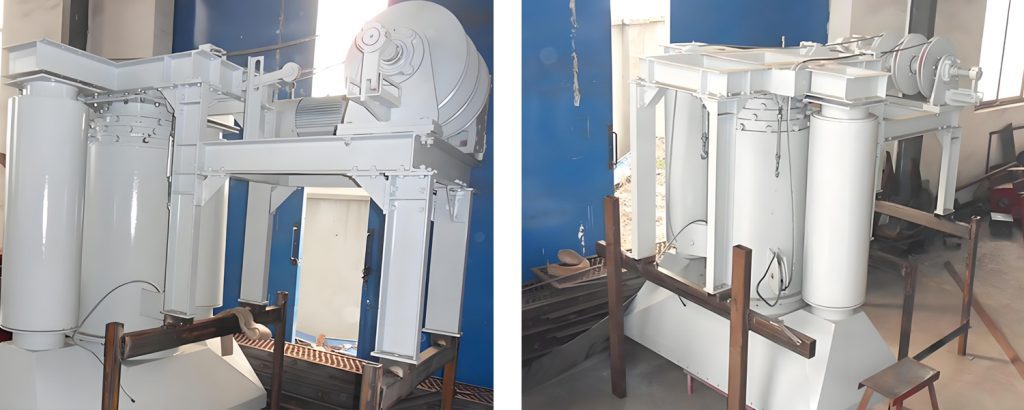
IV. Bulk Loader Working Principle and Operating Steps
A clinker bulk loader works similarly to a cement loader. The steps below also serve as a guide on how to operate a bulk loader.
1.Positioning and Lowering the Spout:
The truck drives into the loading position. Depending on the material type, the operator manually opens a rack bar gate. They set the right number of bars to control the starting material flow.
The operator presses the “lower” button on the control panel. The loading spout lowers into the truck’s hatch. When it reaches the correct position, the lift motor stops automatically.
2.Loading and Dust Collection:
The operator presses the “load” button. The system starts discharging material. The discharge gate opens automatically. Support equipment, like the air slide fan and dust collector, also start.
Material flows through the inlet chute and into the truck. During loading, dusty air inside the spout gets sucked through the space between the spout’s layers and into the dust collector. This process keeps the work area clean. This is a key part of the bulk loader dust collection system.
3.Automatic Lifting and Repositioning:
When the level sensor detects that material has filled the spout (meaning that spot in the truck is full), the system automatically lifts the spout while sounding an alarm. This prevents overflow.
The operator can set the lift distance before loading using a timer relay. For example, if the spout needs to lift 1 meter and the lift speed is V, they set the time to T = 1 / V.
Material continues to flow while the spout lifts. This keeps the process efficient. When the spout reaches the set height, it stops.
The truck driver moves the vehicle forward to the next loading position. The operator then repeats the process until the entire truck is full.
4.Stopping and Finishing:
When the truck is full, the operator presses the “stop” button. This closes the gate or stops the vibratory feeder, stopping the material flow. Other support equipment then stops.
Finally, the operator presses the “up” button to lift the spout to a safe height. This allows the truck to drive away safely.
V. Bulk Loader Selection and Maintenance Guide
For procurement managers and engineers searching for a bulk loader supplier or manufacturer, here are key factors to consider:
Material Type: Different materials (cement, clinker, fly ash) require different levels of wear resistance and sealing.
Site Space: The space under your silo will determine whether you need a silo bottom bulk loader or a silo side bulk loader.
Automation Level: Systems range from semi-automatic to fully automatic bulk loading systems. Your choice depends on your budget and labor costs.
Environmental Rules: Ensure the equipment meets local regulations for bulk loader dust collection and emissions.
Wear Part Life: Ask about the replacement cycle for key wear parts like the loading hose and dust hose. This affects the total bulk loader price.
Through this automatic or semi-automatic process, the bulk loader provides an efficient and clean way to load bulk materials. It is essential equipment for modern cement loading systems and industrial bulk loading equipment worldwide.

 English
  Russian
  French
  Portuguese
  Arabic
  Spanish
  Japanese