
1. Dispositifs d'alimentation des transporteurs à vis
Une bonne conception se concentre sur le pourcentage de remplissage et la méthode de chargement des matériaux. Nous basons nos calculs sur transporteur capacité et puissance en fonction du pourcentage de remplissage choisi.
Nous décrivons ci-dessous différentes méthodes d'alimentation.
(1) Alimentation fixe
Un alimentateur à vis utilise une vis spécialement conçue et scellée dans une auge tubulaire. Elle déplace le matériau d'une trémie à une vitesse déterminée. Le débit ne dépend pas de la hauteur du matériau dans la trémie.
Un alimentateur à palettes utilise un cylindre rotatif avec des poches de volume fixe. Sa vitesse de rotation détermine le débit d'alimentation. Nous pouvons l'entraîner en synchronisation avec la vis du convoyeur ou utiliser un entraînement séparé à vitesse fixe ou variable.
(2) Alimentation en plusieurs points
Il arrive qu'un convoyeur ait besoin de plusieurs points d'alimentation. Un opérateur doit les contrôler manuellement.
Si une seule entrée s'ouvre à la fois, il faut régler la porte ou la vanne. Son ouverture maximale ne doit pas surcharger le convoyeur.
Si plusieurs entrées s'ouvrent, nous devons régler soigneusement chacune d'entre elles. Le débit total de toutes les entrées doit rester inférieur à la capacité nominale du convoyeur.
Si toutes les entrées s'ouvrent et s'alimentent simultanément, nous devons contrôler le flux total de matériaux.
(3) Alimentation à partir d'un bac fixe
L'alimentation directe à partir d'un bac fixe est risquée. Sans dispositif de contrôle du débit, le risque de surcharge augmente considérablement.
Une solution simple et pratique consiste à ajouter un ampèremètre au démarreur du moteur. Cet ampèremètre indique le courant de charge. Il indique quand le convoyeur atteint sa pleine charge. Cette méthode fonctionne bien pour le contrôle manuel de l'alimentation.
(4) Alimentation par inondation
Les matériaux tombent souvent verticalement sur la bride d'entrée du convoyeur. L'impact des morceaux ou des particules qui tombent peut provoquer des dommages ou de l'usure.
Nous pouvons résoudre ce problème en installant un déflecteur ou un coussin dans la goulotte d'entrée.
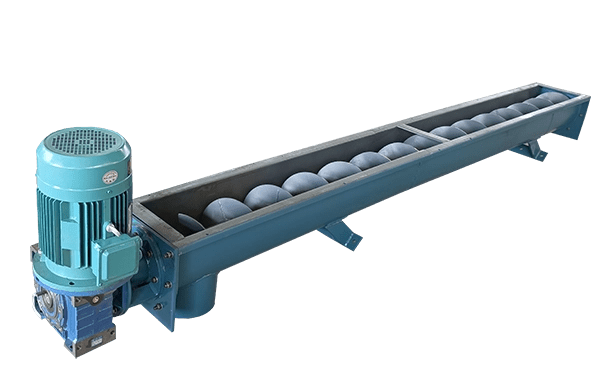
2. Dispositions de décharge pour les transporteurs à vis
Une sortie de décharge standard est très courante. Elle contrôle le matériau déchargé et le dirige vers l'équipement de traitement ou de stockage suivant.
Une sortie de décharge en bout de ligne est similaire. Cependant, la sortie se trouve à l'extrémité de l'auge du convoyeur. Sa bride d'extrémité est solidaire de l'extrémité de l'auge.
(1) Ouverture de décharge sans bec
Les matières tombent directement par une ouverture au fond de l'auge. Nous l'utilisons généralement pour les points de déversement intermédiaires. Le déchargement se poursuit ici jusqu'à ce que la hauteur de chute ait disparu. Un exemple est le déchargement dans un silo.
(2) Décharge par le bas pour les pieux
Nous l'utilisons pour décharger et distribuer des matériaux dans une trémie, un bac ou une pile de stockage. Une ouverture sur la longueur nécessaire du fond de l'auge permet d'évacuer la matière. La matière forme une pile naturelle. Plus tard, le matériau passe au-dessus de cette pile pour atteindre les zones non déchargées.
(3) Débit à l'extrémité de l'auge
La matière se déverse directement par une ouverture située à l'extrémité de l'auge. Une plaque d'extrémité partielle supporte la vis. Le roulement est monté sur la bride d'extrémité. Nous ne pouvons pas utiliser cette méthode si le taux de remplissage du convoyeur est supérieur à 0,45.
(4) Décharge à extrémité ouverte
La dernière section de vis du convoyeur utilise un palier de suspension standard comme support. Cette configuration permet au matériau de se décharger librement dans un bac, une pile de stockage ou un endroit similaire.

 English
  Russian
  French
  Portuguese
  Arabic
  Spanish
  Japanese