
Jaw crushers and cone crushers are the workhorses of primary and secondary crushing in sand, gravel and aggregate mines. But they are also the noisiest sources of dust on a crushing plant. As rock is squeezed, shattered and dropped, the impact, crushing pressure and induced airflow throw up a constant cloud of hard stone powder and fine suspended dust. If the dust collector is undersized or installed carelessly, the result is easy to predict: sacos de filtro that wear out in weeks, dead zones where dust escapes untouched, abnormal pressure drop, and fugitive dust drifting across the site.
Getting pulse jet baghouse dust collector selection and on-site installation right for crusher stations is what separates a compliant, long-running plant from a dusty, compliance-nightmare one. This guide walks through the real operating conditions at jaw and cone crusher stations, the core sizing decisions, and a practical installation and commissioning checklist — with the common faults and their fixes thrown in.
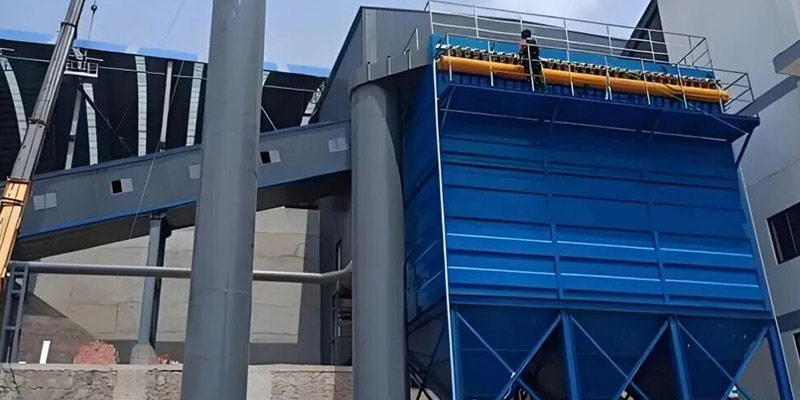
Why Jaw & Cone Crusher Stations Are the Toughest Dust Points
Two very different dust regimes meet at these two machines, and each needs a slightly different approach.
Jaw crushers handle primary crushing of run-of-mine rock. Material falls from a high drop, is crushed under positive pressure inside the chamber, and generates short, violent bursts of high-concentration dust. The dust is a coarse-to-fine mix, and the large stone particles scouring through the system are extremely abrasive.
Cone crushers do secondary and tertiary crushing to finer product. The discharge is finer, the fraction of fine suspended powder is higher, and dust generation is steadier and wider-spreading — the classic recipe for unorganized fugitive dust if the hooding is weak.
Both stations run continuously under heavy dust loading. That demands a sistema de recolha de poeiras with generous, correctly sized airflow, wear-resistant filter media, and stable air distribution. A generic, off-the-shelf selection almost always ends in early equipment failure and failed emissions.
Core Selection: Air Volume and Filter Bags
1. Sizing the Air Volume (CFM / m³·h)
Do not rely on rule-of-thumb guesses. Base the design airflow on three factors specific to the crusher station:
Crusher throughput (t/h) — more rock means more entrained air and more dust to capture.
Feed and discharge drop height — greater drops induce more air and throw dust further.
Chamber enclosure — how well the crusher inlet and outlet are sealed determines how much of the dust is contained for capture.
The goal is to overcome the positive pressure generated inside the crusher chamber and maintain sufficient negative pressure at the crushing chamber, discharge point and transfer chutes so dust is pulled into the hood rather than pushed out. Account for duct friction, bends and small leaks, then add a 10–15% safety margin. But do not oversize aggressively: excess airflow raises face velocity through the filter and accelerates bag abrasion, and it wastes fan energy.
2. Filter Bags: Slow Filtration, Wear-Resistant Media
Follow the mine-industry rule of low filtration velocity, high wear resistance:
Match the total filter bag area to the calculated airflow so the air-to-cloth (A/C) ratio stays low. A lower A/C ratio spreads the load across more bags, slows the velocity of hard dust particles hitting the media, and protects the bags.
Choose anti-static, high-wear, anti-blocking filter media designed for abrasive mineral dust. This materially slows bag pilling, mechanical damage and pore clogging, and keeps filtration efficiency stable over the bag’s service life.
If you are still deciding between a baghouse and a cyclone, or between filter media grades, compare them against crusher-station conditions — for abrasive, high-volume crushing dust, a pulse jet baghouse with durable media is usually the right call.
Ducting & Hood Design: Where Dust Escapes Is Where You Start
After sizing, installation quality is what makes the system actually work:
Mount the collector body level and rigid so long-term vibration does not crack the casing, shift the bags into contact with the cage, or loosen flanged joints and create leaks.
Fit the hoods tight to the real dust points — the crusher feed inlet, discharge outlet and transfer points — with full coverage and enclosure to shut down the escape paths.
Keep the duct layout short and avoid sharp bends and long detours. Excessive bends add friction and create turbulence that can concentrate airflow on small patches of the filter medium and scour the bags locally.
Seal Everything
Pulse jet cleaning only works if the system holds negative pressure. Seal the flanges, inspection doors and cleaning-access points with proper gaskets. Unsealed leaks let air in, drop the available suction at the hoods, and silently push the collection efficiency down even while the fan appears to run fine. Pay the same attention to the pulse-jet cleaning system: even pulse distribution and fast, sensitive response keep the bags from caking and harden the filter cake, so cleaning stays effective instead of the plant battling clogged, frozen bags.
Installation, Commissioning & Operating Checklist
- No-load test — check fan rotation, vibration levels, pulse-valve action and that the pulse-jet control is firing correctly before any material flows.
- Load test — run with material and fine-tune the fan airflow and cleaning intervals against actual dust concentration. Match the peak crushing moments, when dust output spikes, so you neither under-clean (bag caking, blocked media) nor over-clean (unnecessary bag wear and wasted compressed air).
- Measure — verify pressure drop across the collector, emissions at the stack, and negative pressure at each hood after tuning.
Common Crusher Dust Collector Faults & Fixes
Sintoma | Likely cause | Fixar |
Filter bags wear/tear rapidly | Face velocity too high, poor media grade, or localized scouring from bad duct layout | Lower A/C ratio (add bags), upgrade to anti-static wear-resistant media, simplify duct bends |
Dust escaping at crusher discharge | Weak or missing hood coverage, insufficient negative pressure at that point | Extend/enclose the hood, increase suction at that transfer point |
High or unstable pressure drop | Bags caked from under-cleaning, or pulse-jet system misfiring | Reduce cleaning interval, check pulse valves & solenoid timing |
Dust re-entrainment after cleaning | Cleaning too aggressive / too frequent | Extend cleaning interval, tune pulse pressure and sequence |
Static problems in fine powder | Conductive dust build-up | Use anti-static media and proper grounding/bonding |
Maintenance That Protects Filter Bag Life
Even the best sizing job lives or dies on maintenance. Follow a daily inspection and troubleshooting routine — check differential pressure, look for leak points, and inspect bags for pilling and damage. When bags do reach end of life, replace them as a set with matched media to keep filtration uniform. Having the right filter bags and wear parts on hand prevents costly downtime.
FAQ
What size dust collector do I need for a jaw crusher?
It depends on throughput, feed drop height and how well the crusher is enclosed; base the airflow on crusher tonnage and add 10–15% margin, then size filter area for a low air-to-cloth ratio.
Baghouse or cyclone for crusher dust?
For abrasive, high-volume crushing dust, a pulse jet baghouse with wear-resistant media gives the cleanest emissions and longest bag life; a cyclone is best only as a pre-collector for very coarse particles.
Can I use a standard baghouse on an explosive coal or gangue crushing line?
Only if it is explosion-proof (ATEX-rated), properly vented and grounded; never use a standard collector on dust-explosion-risk applications.
How often should I clean a crusher-dust baghouse?
Clean as often as needed to hold differential pressure steady — tune the pulse interval during the load test rather than running a fixed schedule.
Need a Crusher Dust Collection System That Actually Holds Up?
We design, manufacture, install and commission pulse jet baghouse dust collectors and complete dust collection systems for crushing plants, cement plants, mines and more. Get a dust collector sized to your crusher throughput and site conditions, or ask for filter bags and wear parts built for abrasive mineral dust.
 English
 Russian
 French
 Portuguese
 Arabic
 Spanish
 Japanese