
Transportador deslizante pneumático (also called air slide, air gravity conveyor or air slide chute) is a widely used fluidized powder conveying equipment in cement plants and other bulk powder industries. It is designed for conveying free-flowing, fluidizable powders such as cement and raw meal. Many engineers, procurement managers and maintenance teams frequently ask questions about its working principle, aeration fabric types, slope requirement, air parameters and operating procedures. Below we compiled the most common technical questions for your equipment selection, installation and daily operation reference.
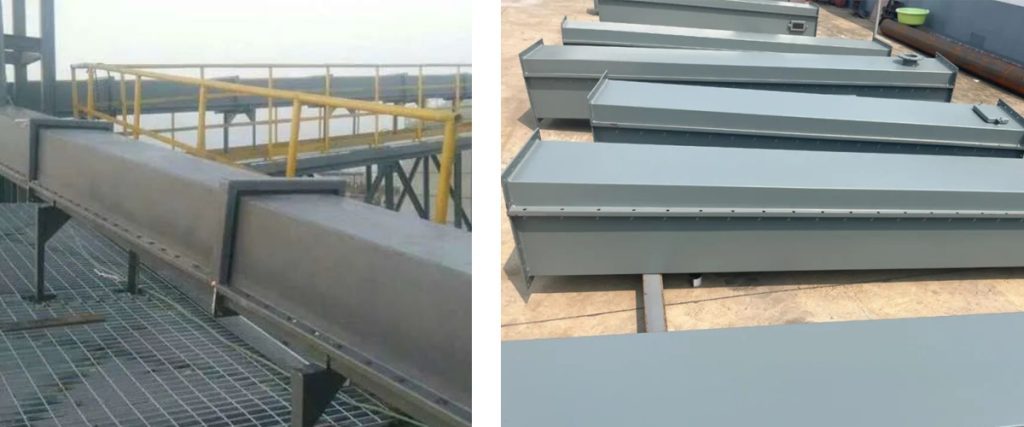
1.What is the working principle of an air slide conveyor?
An air slide conveyor is a fluidized conveying device. It consists of connected steel troughs divided into an upper trough and a lower trough, with aeration fabric installed between them. Pressurized air is supplied into the lower trough. Material is fed into the upper trough at the higher end. Air passes evenly through the aeration fabric and fluidizes the powder material. The fluidized powder flows by gravity from the high end to the low end along the inclined chute to complete conveying.
2.What is solid particle fluidization?
Solid particle fluidization is a process where solid particles are mixed with gas or liquid and gain fluid-like flow properties, which is the fundamental mechanism for air slide conveying.
3.What are the main components of an air slide conveyor?
It generally includes an air blower unit, feeding device, discharge device, upper trough, lower trough, aeration fabric, support brackets and other accessories.
4.What is the function of aeration fabric?
The aeration fabric supports the bulk material while allowing uniform air penetration. It fluidizes the powder to reduce internal friction and enable smooth gravity flow of materials. It is the core wear part of the air slide conveyor.
5.What types of aeration fabric are available for air slide conveyors, and what are their features?
① Canvas aeration fabric: Made of polyester fiber or cotton linen. Polyester canvas has low expansion in humid conditions. It is simple in structure, low-cost and easy to repair. Its main disadvantage is limited heat resistance.
② Porous ceramic plate: Flat surface and high temperature resistance. Weaknesses: low mechanical strength, vulnerable to impact and breakage, inconsistent air permeability, rarely used nowadays.
③ Cement porous plate: High strength and can be fabricated on-site, with limited application.
④ Synthetic fiber aeration fabric (mainstream new type): Thickness 4~6 mm, continuous temperature resistance ≥150°C, radial breaking strength 4700 N/cm width, air resistance 800~1200 Pa. It features good wear resistance, uniform air permeability, proper rigidity and low moisture absorption. It is the preferred option for most cement plants.
6.What are the standard sizes of air slide conveyors and what materials can they convey?
Standard widths: 250 mm, 350 mm, 400 mm, 500 mm, 630 mm, 800 mm.
✅ Suitable materials: Cement, raw meal and other easily fluidized fine powders.
❌ Not suitable: Coarse particles, high-moisture materials and powders with poor fluidization performance.
7.What are the advantages and limitations of air slide conveyors?
Advantages: No rotating parts, low noise, light weight, low energy consumption, simple structure, large conveying capacity, flexible flow direction, available for multiple feeding and discharging points.
Limitations: Strict requirements on material moisture and air dryness; high moisture easily causes blockage. The air slide must be installed with a fixed slope, which brings restrictions on layout.
8.What are the recommended slope, air pressure and air flow rate for air slide conveyors?
Common slope ratios: 6%, 10%, 14%, 18%, corresponding to approximately 4°, 6°, 8°, 10°.
Note: A steeper slope improves material flow but increases layout difficulty. For cement and raw meal, the slope is recommended to be no less than 7%. Long-term operation under 6% slope carries a high risk of blockage.
Air pressure: 4 ~ 5.5 kPa
Air flow rate: 1.5 ~ 2 m³/(m²·min)
9.What is the standard operating procedure for an air slide conveyor?
① Before startup: Check all sealing points carefully to prevent air leakage at the trough and aeration fabric.
② Startup: Keep the blower inlet valve closed at first. After the motor starts, gradually open the air valve to adjust airflow and set the air baffle of the lower trough, then start feeding material.
③ Shutdown: Stop feeding first. Reduce the air valve gradually as the material inside the chute decreases. Keep the blower running for another 2~3 minutes after all powder is conveyed, then stop the fan. In case of emergency shutdown and long standby time, open the cover and clean residual material manually.
④ During operation: Monitor material flow status continuously and adjust air volume as needed.
⑤ Prevent large lumps and debris from entering the air slide. Clean the upper trough regularly to avoid blockage.
⑥ Strictly control material moisture. The supplied air must be clean and dry to avoid clogging the aeration fabric.
10.What are the common causes of air slide conveyor blockage?
- Excessively high material moisture leading to poor fluidization
- Humid process air that clogs the aeration fabric
- Insufficient installation slope
- Foreign objects or large particles stuck inside the chute
- Insufficient airflow, failing to fully fluidize powder
11.How to replace the aeration fabric of an air slide conveyor?
First, shut down the blower and stop feeding, confirm the equipment is locked out. Remove the top cover and the old damaged aeration fabric. Clean the trough frame thoroughly to remove residual powder and sharp burrs. Lay the new fabric evenly without wrinkles or tension imbalance, then fix and seal it tightly. After installation, perform a no-load air test to check for air leakage before formal feeding.
12.What blower is matched with an air slide conveyor?
Generally, roots blowers or centrifugal blowers with stable pressure output are adopted. The blower must provide clean, dry and stable low-pressure air. The blower model is selected according to the chute width, total length and layout of the air slide.
13.Can an air slide conveyor run horizontally?
No. An air slide conveyor relies on gravity to transport fluidized powder. Horizontal installation cannot realize material conveying, so the inclined slope is mandatory.
14.What is the service life of aeration fabric?
Service life depends on material temperature, moisture, air cleanliness and operating hours. Under normal cement plant conditions, polyester and synthetic fiber aeration fabric can last 6–18 months. Poor working conditions will greatly shorten its service life.
15.Is it possible to arrange multiple discharge points on one air slide conveyor?
Yes. Air slide conveyors support multiple discharge outlets with gate valves. You can discharge materials at different positions according to process requirements, which is one of its prominent advantages.
If you need technical support for air slide conveyor selection, layout drawing, quotation or replacement aeration fabric, please contact our engineering team with your working conditions. We provide customized powder conveying solutions.
 English
 Russian
 French
 Portuguese
 Arabic
 Spanish
 Japanese